



In search of God:
the modern world looks for answers
Editorial FAITH Magazine September-October 2001
God in the news again
Channel 4 (hardly a TV channel noted for its pro-Christian bias) is currently running a series of programmes called 'Testing God'. Despite its provocative title, the trailer for the series sums up the central theme in this way: "We used to use God to explain the universe until science came along and explained everything and put God out of the picture. But is God really dead? Four explores the relationship between science and religion and finds that God is alive and well." This is only the latest in a growing number of pieces in the popular media which are asking serious questions again about science and religion.
The motive is not just intellectual curiosity. There is a widespread feeling that our culture has lost its way and a pervading sense of disillusion with unbridled materialism which has failed to nourish the human spirit. It is true that there is still enormous prejudice against Christianity in general and Catholicism in particular in the UK, however there is a definite stirring of interest in the questions which religion alone can answer. And one of the greatest challenges to the credibility of the answer given by the Church in the modern world remains the discoveries of modern science. We live in a universe whose inner coherence is quite breathtaking. There is much still to discover, but we have arrived at the broad outlines of the laws and patterns which describe a universe that evolved from a 'primal singularity' to the busy brain of man in a single, majestic sweep. It is a cosmic vision of unity and cohesion that far exceeds the rather crude sense Darwin originally gave to the word 'evolution'. Darwin himself never claimed to be an atheist, but there is little doubt that this was a key moment in the loss of contact between theology and science in modern times.
The impact of the scientific revolution
The mutual prejudice was then reinforced during the arrogant adolescence of science in the twentieth century when the sheer pace of discovery and insight, especially in physics, bred a sense within the scientific community (with notable exceptions like Einstein) that 'God' had indeed been made irrelevant. And if God was out of fashion, then man too had been knocked off his perch. No longer were we to think of ourselves at the centre of creation, but as a biological accident on an obscure rock at third remove from a minor star on the outer edge of one small galaxy.
Such a shift in world view was of course utterly revolutionary and eventually quite devastating for the Christian faith of the ordinary man and woman. Yet tragically, and with notable exceptions again, the theological establishment utterly failed to address this revolution and to evince a renewed vision of Christianity and a new apologetic to speak to the mind as well as the heart of the modern world. However in the meantime, science itself has come almost full circle, and now at the very point where the last gaps in our knowledge of the cosmos look set to close, the question of God is re-emerging. This is because the very laws and constants we have discovered, the framework of meanings and purposes which make the universe a going concern, themselves require a context and an explanation. Far from excluding a creator, the sheer unity of it all bears witness to a Mind outside the process and yet intimate to it.
Rediscovering perennial principles
Of course Christianity never did believe in a fairy tale God who waved a magic wand, or 'twiddled with the dials' in some arbitrary way. Thomas Aquinas' arguments from causality to God's existence were based on a perception of the contingency of meaning and purpose in all that exists, not on 'who lit the blue touch paper'. It is these principles which urgently need re-expressing in terms of scientific language and discovery in order to meet the modern world on its own spiritual quest.
Our own place in the cosmos too is being reassessed by some secular cosmologists in fascinating ways. They note that the laws of the universe are uniquely tailored to produce just such a world as can contain ourselves with our enquiring minds. Perhaps we are at the centre after all. It does not matter where we are placed on a map of the stars (space is relative in any case), it is the power of mind, the power to interpret and control the world that places us at the centre of immensities. It is even suggested that our own existence might be the 'key' to the laws of physics in the first place. Here again the traditional Christian vision of man and creation is crying out for re-elaboration and explanation in contemporary terms.
A missed opportunity
In short we have something important to say to the world on these topics. But at the very moment when science itself is paving the way for our contemporaries to hear the Word of God again, we find the theological and catechetical establishment looking the other way. Cosmology is the ‘in’ thing in secular discussion right now, but it could hardly be more unfashionable in the Church. It is often seen as a specialist issue, of academic interest to a few but of no great relevance to the mighty task of re-evangelising the West.
This is a nothing short of a tragedy and a missed opportunity. There are, of course, those who have noted the problem, but too often they fail then to develop a truly convincing synthesis of science and religion. We must show modern man religion as something more than just a subjective appeal to the heart. We must be able to justify the bold claim made in the Catechism about the unity of God’s wisdom and providence which runs through both creation and revelation:
Catechesis on creation is of major importance. It concerns the very foundations of human and Christian life: for it makes explicit the response of the Christian faith to the basic question that men of all times have asked themselves: "Where do we come from?" "Where are we going?" "What is our origin?" "What is our end?" "Where does everything that exists come from and where is it going?" The two questions, the first about the origin and the second about the end, are inseparable. They are decisive for the meaning and orientation of our life and actions.
Thus the revelation of creation is inseparable from the revelation and forging of the covenant of the one God with his People. Creation is revealed as the first step towards this covenant, the first and universal witness to God's all powerful love. (CCC 282 & 288) What is an even greater tragedy is that the one well known attempt by a Catholic theologian to present Christ in terms of a scientific understanding of the cosmos in recent years, that of Pierre Teilhard de Chardin, lost sight of the essential distinction between matter and spirit and so ended up blurring the distinction even between God and the world. Whilst his work was brave and prophetic in many ways, these flaws render him unsafe as a basis on which to build our new vision. It has also created prejudice in some quarters against any such project. But the job still remains to be done, and urgently so.
A Vision of the primacy of Christ
Faith movement has been a voice in the wilderness on this subject for many years. There certainly seems to be a more ready audience for these things in the secular arena at the moment, maybe we can hope now for a more fruitful dialogue and collaboration within the Church for the sake of the Gospel. However it is vital to understand that the idea of a 'new synthesis' is about much more than just the question of 'the existence of God', or 'science and religion' as an intellectual discussion. The essential mark of the new synthesis of contemporary science and revelation which is offered through the Faith Movement is that it re-vindicates the primacy of Jesus Christ over all creation, throughout history, culture and society, and within the individual mind, heart and body.
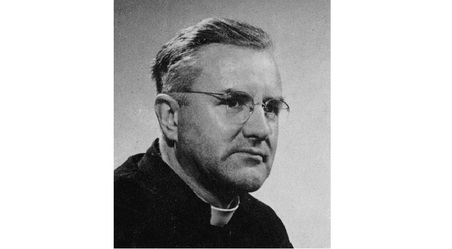
The particular synthesis which we promote arises out of the principles outlined by Agnes Holloway (in her book God's Master Key: The Law of Control and Direction) and more fully elaborated by her son Fr. Edward Holloway (in his book Catholicism a New Synthesis and other writings). It was her claim, in all simplicity, that these principles were given to her as divine promptings and locutions, but of course no one is obliged to accept (or indeed to reject) the spiritual claim behind these ideas. They are recommended simply by their usefulness and authenticity in promoting and explaining the Catholic faith in the modern world.
A key insight
No claim is being made to answer every question immediately, nor that we have a pre-packaged solution to all the problems which face the Church. But these principles do supply a vital and immensely synthetic insight which can be applied fruitfully to key aspects of Catholic faith and life. Many of us find in them a beautiful and compelling answer to much of the confusion and contradiction in both teaching and practice which afflicts the Church at the dawn of the third millennium.
The insights given through Agnes Holloway are summed up under a key concept - a "Master Key" - which opens many doors of development in doctrine and philosophy, which she called "The Unity Law of Control and Direction". It presents the whole of Science and Revelation as one Wisdom proceeding in interlocking ways from the transcendent Mind of God. The Mystery of Creation and the history of Salvation can then be shown anew to the world with great clarity and power as the one unfolding plan of God's love in which all things are ordered towards the incarnate Lordship of Jesus Christ in whom we are destined to be made "co-sharers of the divine nature" (2 Peter 1:4).
A new perspective
One of the core principles of this ‘Unity Law’ - so called because it encompasses and subsumes all the partial ‘laws’ of creation - as proposed by Agnes Holloway is that ‘matter is that which is controlled and directed, mind is that which controls and directs’. At first sight this may seem a strangely technical and rather prosaic statement, but it turns out to be a surprisingly precise and relevant answer to many contemporary issues.
We are able to argue this as a principle of metaphysics which solves many long standing problems in philosophy like that of ‘matter and form’ and knowledge through the senses. Science too, from its own standpoint, is coming to see that matter-energy is not self explanatory; even in its ‘quantum’ foundations it is something inherently bounded by dynamic laws of creative possibility. Science points to transcendent mind in order to ensure its own coherence. It is also a principle which can be applied usefully in theology. The relationship between God and the world, the natural and the supernatural, matter and spirit, can be neatly synthesised along these same lines without losing the distinctions essential to orthodoxy. From this starting point we can offer a catechetical perspective of creation through evolution by which we can show clearly the transcendent existence of God and the essential distinction between the body and soul within the seamless unity of God’s creative plan. We then offer a vision of God as the true Environment of men, or to put that same thought in scriptural terms: "In him we live and move and have our being" (Acts 17:28). We can trace his unfolding purpose in the relationship of word and grace through the prophets which is brought to its true head in Jesus Christ, the Son of God and Son of Man. He is the Lord of creation, the centre of history and the unique and definitive fulfilment of our humanity. The mystery of redemption through the death and resurrection of the Lord, following the tragedy of original sin, far from being relativised is seen in its crucial and central focus. Our life in the Holy Spirit through Church and sacraments and the necessity of an infallible Magisterium likewise flow naturally from this presentation of Christ and his work. Our understanding of the role of Mary, the Virgin Mother through whom God comes into his own things in the flesh (cf. John 1:10 -14), is also greatly deepened and enhanced. So too the dignity of Man, made male and female as the sacrament of Christ and his Church (cf. Ephesians 5:32), is strikingly reaffirmed, and from this many of the Church's moral and social teachings can be beautifully explained and underlined. Through this same vision we are able to teach and encourage the way of holiness and prayer as personal fulfillment in both wisdom and joy through humble union with the Father through the Son in the Spirit. We can also show how this communion of life and love is made perfect in the Eucharist, the Sacrifice and Sacrament of Christ, our God and Saviour, ‘Heir of the Ages’ and King of the individual mind and heart.
A collaborative task
We make no claim to infallibility in opinion nor exclusivity in theology, but nonetheless we are convinced of the unique and essential contribution to the renewal of the Church which the vision of the "Unity Law" of creation in Christ will make. This vision forms the core identity of Faith and is its sole reason for existing as a distinctive movement in the Church.
In this extended issue of FAITH magazine we are happy to publish pieces from a range of contributors, not necessarily in full agreement with our own line, who bear witness to the growing importance of this question. At the very least some such vision which reconciles science and religion and vindicates Christ as the Lord of his creation is urgently needed today, especially as our culture is now openly looking again for answers to the most fundamental questions about human existence