



Articles
Eucharist

How Is The Mass A Sacrifice?

Editorial FAITH Magazine May-June 2001

The Mass a ‘family meal’?

It has been popular in catechetics for some time to present the Mass as a 'family meal' of the local community, whether this is thought of as the parish, or the 'small group', or even as a school or other such institution. When presented in these terms it is inevitable that liturgy is thought to belong only to the local culture, even that the efficacy of the celebration comes from its power to 'speak' to the local situation. 'Making eucharist' is seen as making explicit through signs and symbols the spiritual values which are already present or at least latent in the group. One problem with this approach is that it creates a false expectation of Mass as something which must always be a social and emotional high. The gap between this and the contemplative reality of the Church's liturgical tradition has led to much shallow and unauthorized liturgical experimentation. The ensuing sense of constant deconstruction of the sacred has done much to alienate the older faithful and has signally failed to hold most of our young people too.This is not to say that there is no room for the expression of genuine spiritual joy in the Mass, but if we portray the liturgy purely as a human celebration of togetherness, then we cannot hope to compete with the modern world in terms of sheer dazzle and technological entertainment. The chief fault of this sort of Eucharistic catechesis, however, is that it ignores the central doctrine that the Mass is the Sacrifice of Calvary, renewed and offered in an unbloody manner for the salvation of the living and the dead. It is noticeable that such teaching normally emphasizes the Eucharist as a representation of the Last Supper, whereas the older catechetical tradition emphasized the relationship of the Mass with Good Friday. We may well need a fuller synthesis which embraces both emphases and also goes on to include Easter Sunday, Ascension Thursday and Pentecost too. But there is no doubt that in many people's minds the Eucharist has been reduced to a mere communion service - a 'communion' that increasingly lacks almost any transcendent reference or goal. 

The theology of ‘story’

A more subtle form of thinking has emerged in the last few years which does attempt to deal with this vital aspect of the Eucharist as memorial and sacrifice. Consequently it can sound more reassuring as it adopts some of the traditional language of the Church. However, when unpacked, its account of the liturgy is similarly subjective and devoid of transcendence. This theology begins with the idea of 'story' as its paradigm. Retelling the story of redemption, it is claimed, alters our thinking and hopefully therefore our behaviour. The narrative shapes our collective consciousness along the lines of the story we tell, so that we too then become part of this ongoing 'story' of salvation. Thus, according to this way of thinking, the Mass can be called the 'Sacrifice of Christ' because, in the act of calling to mind and dramatically representing our shared faith story about the life and death of Jesus, the event is made ‘present’ in a way that transforms the participants. This approach does at least have the value of maintaining a universal rather than a merely local relevance to the liturgy. But a notable consequence of this sort of thinking is that the 'story' itself is the point. In the last analysis it would not matter whether the persons and events in the story were real and historical or not. They could just as easily be mythological. In fact, just as in all good myth, it is the ethical example and the symbolic implications of the Gospel drama, not so much the person of Jesus himself, that makes it universally relevant and powerful. But if this is all the saving effect of the Eucharist consists in, then it is open to question whether our particular religious actions have any more validity or effectiveness than the myths and rituals of other traditions. Even if we do insist that the Gospel is the definitive story of salvation, it is still true that the story of Jesus has become more important than the person of Jesus. He 'lives' only in the words and symbols of our proclaiming and celebrating about him. Indeed it is sometimes even asserted that the people who are transformed by such celebration are more truly the 'real presence' of Christ than the transubstantiation of the bread and wine.

 Philosophical idealism at the root of the problem

At the root of this outlook is a philosophy which effectively reduces reality to nothing but the mythical and ideal in the first place The objective order of historical, bodily existence is considered to be no more than the external symbolization of universal, subjective Spirit. When translated into theological terms, it is not so much that the category of 'faith story' becomes more important than sacramental reality, but that telling the story becomes the saving reality. When further translated into popular language and culture this really just means that Christianity is no more than a fairy tale. As one mother of a young family once put it: "They have turned Jesus into Spot The Dog!" - Spot The Dog being a cartoon character in books for toddlers which teach them basic life strategies. Every child knows that 'Spot The Dog' is fictional, but he represents and incarnates certain abstract truths which are supposed to be absorbed and implemented. The catechesis of 'story' makes Jesus into a cipher, an 'incarnation' of ‘Gospel values’ which are the real object of our belief and striving. The net outcome of such theology is not only subjective but thoroughly Pelagian. It undermines any sense of the sacraments as the grace filled and redeeming actions of Christ in Person through His Church. It not only separates faith from history (thus the infamous and false distinction between the 'Jesus of history' and the 'Christ of faith') but from any living love for Jesus as our personal Saviour. 

Recovering the full Mystery of Faith

We can suggest a much better starting point and a more fruitful approach to explaining the Eucharist as the objective Sacrifice of Christ. We start with the familiar thought that we are called to be 'co-sharers of the divine nature'. The great goal of creation is communion with the Blessed Trinity. Of course this must also mean communion with one another in charity and justice (caring and sharing, if you like), but that will only come about by our being gathered into, and formed by, the eternal love and holiness of Father, Son and Holy Spirit.In other words the communion we seek is the work of God among His creatures, a work of grace achieved in real history, through real actions, persons and events. It cannot be just a symbolic story or a cognitive paradigm shift in our own subjective consciousness, prompted by our own religious imaginations and traditions. Creation and history are themselves founded upon the relationship of grace, upon the Self-giving of God who creates all things unto Himself as the source of Life, and Life to the full. So the divine actions which form the ‘salvation history’ recorded in the scriptures and the sacramental economy of the present dispensation are intrinsically related. They are the unfolding of a single creative plan of wisdom and love. 

Christ our High Priest

Jesus Christ, the Son of God and Son of Man, is the key to, and centre of, this great plan which begins with creation and extends to the parousia. So the work of Jesus (which is always from the Father and in the Holy Spirit) cannot be confined to the three years of his public ministry in Israel. He is revealer and author of the Great Covenant of Communion between men and God throughout the ages and to the ends of the earth. This Covenant which was prepared from the beginning of creation, is fully established among men in his own humanity through the Incarnation; it is vindicated, ratified and consummated in the Paschal events of Easter; but it also, of logical and loving necessity, continues until his second appearing, when it will be fulfilled in the final purification and transformation of the children of God in the Holy Spirit, to the glory of God the Father. On this perspective we can see more clearly how the Eucharist is so much more than a memory of saving events from the past. Jesus himself is the 'Sacrament' and 'Sacrifice' of creation. These are not just human actions that recall his completed work, they are aspects of his Person in relation to his brethren across history. 

Sacrifice and sacrament: the essential meaning

A sacrament is an action of God through his creatures which establishes and increases life and life abundant among his people; and a sacrifice is an action of Man towards God by which we seek to establish or renew communion with our Maker. In Jesus therefore, both are perfectly achieved. As Son of God he is the Sacrament of the World - giver of divine life and sanctification through the flesh. As Son of Man he gives himself to the Father as the all-sufficient Sacrifice of reconciliation and perfective love on behalf of all mankind. The definition of sacrifice as: ‘any work by which we inhere and abide in the divine life’, comes from St. Augustine, and is useful because it does not necessarily include death as essential to the primary notion of sacrificial offering. It is not first and foremost a punitive and guilt driven concept, but one of consecration, adoration and union. In its primitive origins a sacrifice is anything that is wholly given over to God as a token of one's self given over in filial love and obedience. So the thing given had to be the finest, and it had to be wholly given up in total dedication to the sacred. This was the essential meaning of the destruction of the sacrificial gift. Of course such an action easily incorporates the idea of sacrifice as the expression of sorrow for sin and of making reparation too, and this becomes greatly emphasized in a faithless and fallen world. But even in the Old Testament not all sacrifices were of atonement. They could be thanksgiving and communion offerings too. The Sacrifice of Christ gathers up all of these meanings into one perfect offering, made vicariously in his own humanity as Head of the race. It is simultaneously a sacrifice of atonement, of communion and thanksgiving for victory achieved.

 Sacrifice not always bloody

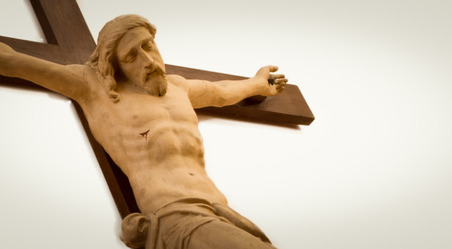
However, even as atonement we must remember that its redemptive power does not lie in the pain of crucifixion as such, but in Christ’s perfect obedience to the Father and his superabundant love for us which endured through the pain unto death, and which endures still through our sins and failures, pleading with the Father both for our forgiveness and our eventual perfect sanctification in the Beatific Vision. So the Church speaks quite legitimately of the one same Sacrifice of Christ as having been initiated in a bloody manner on Calvary but continuing 'in an unbloody manner' in the Eucharist. The dying is done, but the offering remains until he comes in glory.The Sacrifice was not the violent death as such anyway, it consisted in the Person who endured that death on our behalf and who stands for ever in that intercessory relationship between God and Man. His death is "once and for all", but he lives for ever now in his humanity making intercession for all. Neither should we think of this eternal relationship of intercession as abstract and remote, a frozen moment in the heavens, which we approach at one remove here on earth. Christ lives still in history and offers himself still 'in real time' through his Church on earth. At the Last Supper he gave himself to his Church as her all sufficient Victim to plead before the Father in all our daily needs. As High Priest to the Church he offers his sacrifice for the actual, local needs of his people by the hands of his delegated ministers in parishes and chapels across the globe. 

Christ our Saviour in time and eternity

This intersection of time and eternity in the Person of the Risen Lord is what makes the Sacrifice of the New Covenant both an offering of intercession, sorrow and atonement and, simultaneously, the great heavenly feast of Thanksgiving (Eucharist) and pledge of final triumph. This may be a novel angle on things to those who are used to thinking of redemption exclusively in terms of the Lord's death on the cross, which we then try to relate somehow to our current liturgical action. But if we start from a Christ-centred point of view on creation and history, we can overcome the tensions and difficulties of integrating the past and present works of Jesus. To offer himself as Sacrifice and to give himself as Sacrament belongs to his abiding identity and work among us through the ages. This is why the Mass can never be just the expression of a local 'eucharistic community'. It is the 'Wedding Supper of the Lamb' which is universal and eschatological in its scope. Our concept of 'The Paschal Mystery' should not be collapsed onto the three days of Easter alone - whether as event or as narrative proclamation - crucial though these are. Rather the Mystery in full encompasses not only the saving events of the past, but also the present historical moment, together with whatever is the measure of purgation for those who have died still imperfect in charity, and the eternal 'now' of the saints in heaven. In fact one could say that the Paschal and Eucharistic work of Christ extends from the beginning of creation to the utter completion of the Father's plan. Naturally therefore it includes all the sacramental actions of the Church within its one saving agenda.So rather than trying to derive the Eucharist from the Cross in some complex and tenuous way, it is surely simpler and truer to say that the Eucharist went to the cross. Jesus consecrated Himself in his Body, Blood, Soul and Divinity as the universal Sacrifice of atonement and thanksgiving and as the Sacrament of nourishment and healing for all mankind on Holy Thursday Night. As our Eucharistic Sacrifice and Sacrament he was then marked with the sign of the cross, anointed with the blood of suffering and accepted by the Father in the great cry of apology on Calvary on Good Friday afternoon. His victorious power as saving Sacrifice and Sacrament was then vindicated on the first Easter Sunday morning, taken up to the Father as the pledge eschatological fullness on Ascension Thursday, and activated as a sacramental ministry in the Church on earth from Pentecost Day onwards. 

Memorial is more than remembering

So the Mass is not somehow a 'repeat' of the cross, but neither is it its mere dramatic re-enactment. Calvary included the Mass as part of its redemptive action and efficacy. The Eucharist is neither an add-on nor merely a memory of an otherwise completed event, it is the fuller working out of the Incarnation, Death and Resurrection of the Lord. It is not a piece of thought provoking local theatre or just the retelling of a mythically significant story, it is the realization of the work of Christ in the here and now, through the real and active presence of his Incarnate Person in the Eucharistic species par excellence, and in the ministry of saving love which he delegates through his priests and his people. Even the Hebrew concept of memorial - 'zikkarun' - meant more than story-telling to evoke a transformation of cognitive outlook. It meant the acknowledgement of God's continuing saving action which had begun in the historic events of the Exodus and which were awaiting their completion in a definitive redemption in the future. To call the Eucharist ‘memoriale Domini’ - the memorial of the Lord - means that he who once died and is now risen is living and present, objectively and substantially, and is offered still as Sacrifice of union and communion with God for us who are gathered at his altar. His Covenantal Sacrifice is not a thing of the past, only to be recalled and rehearsed like some endlessly repeated TV drama. The cry of boredom at Mass from adolescents comes partly from this sense that it is the wordy repetition of a deed long since dead and done. A theology of 'story' does nothing for the fractious teenager, who interprets such theories as little more than the language of the nursery. It gives them no appreciation of the divine realities that are actually unfolding. If on the other hand we teach Jesus Christ as the key to the meaning of the Universe, the centre of history and the source of life and life more abundant for each of us, who lives literally and personally among us in the Blessed Sacrament, who loves us and gives Himself for us in the here and now though the Eucharistic Sacrifice, and who will perfect us and the whole of creation at His final appearing, then we have a vision of depth which can hold both mind and heart through the most lacklustre liturgy. This does not mean that we neglect the imperative of conversion and the call to build community which is inherent in the Eucharist. The Mass is indeed supposed to bear fruit in personal holiness and mutual charity. But these things come from the sacramental presence of Christ and from his sacrificial action, not the other way around. The word ‘atonement’ is sometimes interpreted creatively as: ‘at-one-ment’, in order to point out that it means the restoration of loving communion between God and men. We should emphasize too that reconciliation with God in Christ is primarily through the Mass as Sacrifice (not just as ‘Holy Communion’) and that this is the wellspring of our mutual ‘at-one-ment’ as the Christian family. We might then also suggest that the word ‘remembering’, when applied to the Mass, could be similarly construed as ‘re-member-ing’, to make the point that in the Mass we don’t just recall Jesus, we are literally joined to him as members of his Body, and offered with him so that we too might become ‘an everlasting gift’ to the Father.

 The Liturgy: universal and transcendent

The Mass is the most powerful prayer of all. But its power does not derive from the enthusiasm of its participants, nor the dramatic impact of our storytelling, rather from the presence and action of Christ who gives himself for all and to all. This is why there can never truly be such a thing as a 'private Mass', even when it is a so-called 'house Mass'. This would be to accept a closed Eucharistic community, which is a contradiction in terms. The universal community of the redeemed on earth is always, by the union of grace, present at every Eucharistic celebration, and the saints and the angels are indeed a very literal, if unseen, presence wherever Mass is offered. So the Mass is never the private possession of any group.

 The liturgy is the property of the whole Church in heaven and on earth. At any celebration, anyone of God's people has a right to turn up and not to feel excluded by the peculiarity of the celebration. What sustains and informs the celebration is not the personalities of the ministers who perform their duties at God's altar, but the Personality of Jesus Christ who is always and everywhere, for all times and cultures, the source and summit of our life, joy, healing, thanksgiving and celebration.