



Articles
Adam and Eve

Adam & Eve by Rembrandt
National Gallery of Art, Washington (detail)
Jesus Our Redeemer

Editorial FAITH Magazine March 1997 by Tim Finigan

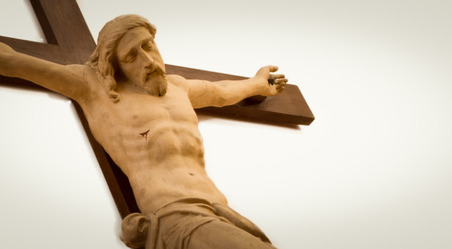
The Good Friday walk of witness has become in many places one of the “fixtures” in the ecumenical calendar. Thank God that it is so; the cross of Christ can speak to the people in our hard hearted and secular society with a power that few other images of our faith can equal. The cross and the stations of the cross which often feature, at least in part, in such celebrations are also relatively uncontroversial. We can all agree that Jesus did in fact die and that it was a painful road to Calvary. Recalling the events of the passion can speak to us all.

It is a different matter when we come to the question of what exactly Christ’s death does for us. In ecumenical style, we can all agree that in some sense or other “Christ died for us” is an important affirmation but what exactly are we affirming?

For many more liberal Anglicans and indeed Catholics whose religious education depended on the policies that have been followed in catechetics over the past twenty years or so, the death of Christ shows us that Jesus was the leader of God’s people and died because of their selfishness. But God was very pleased with his dedication and self-sacrifice and if we all follow his example, the world will be a better place. “Salvation” means “being fully human” and Jesus shows us what it is to be fully human.

Catholics who have not had any deeper understanding of the redemption than this may well be attracted by the more robust evangelical substitutionary theory of atonement. This takes the scriptural affirmation that Jesus died for us and makes Christ’s death a substitute for the punishment that we would otherwise have had to suffer. Sin deserves punishment and there is no escaping it. Without Christ’s death on the cross, we would have been lost. But God loved us so much that he sent his Son and accepted his death as the punishment and so cancelled our debt to him. To some degree or another, it is this punitive-substitutionary theory that makes up the theology of atonement of many evangelical Christians. It is one of the most serious drawbacks in the idea of accepting the Alpha course in a Catholic context. Since we have all but given up talking about the atonement in popular catechetics, even a crude substitutionary theory may well slip by unnoticed.

Although such a theory is generally preferred by evangelicals because of its supposedly scriptural roots, it nevertheless relies on a particular slant given to a few chosen proof texts from scripture. And as with most sola scriptura theology, there is little discussion after the texts have been quoted. There is no explanation given as to why God would be so churlish as to demand the death of his Son. If the punishment can be cancelled because of Christ’s death in our place, would it not have been possible to cancel the punishment anyway? Was it necessary to go through to the bitter end? And what kind of a Father could God be who would subject his Son to this punishment? God loved the world, we are told but on this understanding of redemption, it does not sound as if he loved his own Son.

The whole thing makes God sound like a particularly dogmatic and unyielding headmaster. It is possible to understand the doctrine of the Redemption without this horrendous view of God the Father and without reducing the death of Christ to a noble example of dedication and selflessness. We can say that Christ died to take away our sins but we do not need to make his death the means to satisfy a “demand for justice”.

In explaining the necessity of his own suffering, Jesus told the parable of the unjust husbandmen. The King was not demanding justice or retribution in the first instance but the produce of the vineyard, the inheritance. It had fallen into alien hands and needed to be restored. When the son was finally sent, it was not part of the intention that he should be killed. His was the final invitation to the servants to hand over the inheritance so that it could be given to the Father. The plan was for them to be converted, not punished. “They will respect my son”, the Father said.

Then before Pilate, Christ tells of the “greater sin” of those who have handed him over. From the cross, he asks the Father to “forgive them for they know not what they do.” The death of Christ is the ultimate blasphemy, the sin beyond all others. There is not a shred of evidence in the scriptures that the Father takes any satisfaction in the death of his Son or that he is in any way “pleased” by it. On the contrary, as St Paul says “the wages of sin is death, but the free gift of God is eternal life in Christ Jesus our Lord.” (Romans 6:23) If the Lord does not take pleasure even in the death of the wicked man, he certainly does not take pleasure in the death of his Son. The pleasure of the Father in the Son is proclaimed at the Baptism of Christ and at the Transfiguration. At the crucifixion, there is darkness over the face of the earth and the veil of the temple is torn in two.

The basic flaw in the substitutionary theory of the atonement is in making both sin and redemption incidental to the life of men. From the time of Luther’s “Tower Experience”, the theology of the reformation has tended to make the justice given to us by Christ’s death an imputed righteousness, something that does not intrinsically enhance our being but rather a “letting off”, the numbering of us among the elect. Certainly this privilege of being written into the book of life is entirely due to the sacrifice of Christ but that sacrifice has a real effect within us. The reformation theologians could not admit that because of their insistence on the total corruption of the soul by sin.

It is not in fact possible for our sins to be simply discounted or overlooked precisely because they have caused a real damage to our being. When Christ healed the paralytic, he did not simply declare him healed and leave him on the mat. He healed him so that he could walk again. Similarly, the work of restoration that is brought about in us through the Redemption is not simply a declaration of righteousness but a real work by which we are interiorly healed and renewed in the image that has been disfigured within us. The damage done by sin is not a sentence imposed by God arbitrarily but the effect in us of living a disordered life that contradicts the natural law of good and true in which we were created. It is indeed a wounding of our nature but one that is capable of being healed.

Therefore the work that Christ carries out is much greater than a substitutionary theory would imply. Christ is not the whipping boy who takes our place to “get us off” our punishment. He is the Son of God and the Son of Man whose every work from the beginning of his life on earth serves to restore the communion that was lost by sin. In Faith, we have always taught the view that without sin, the Incarnation would still have taken place. In this case, we might legitimately speculate that the Incarnation and salvation in the positive sense of the giving of “life and life more abundant” would have been simply a glorious progression taking the Kingdom up to the Father without any opposition, simply raising us to glory.

It is sin that makes this Salvation a work and a work of agony, blood and anguish. Although we would say that immolation is not the essence of sacrifice and that the death of Christ is not demanded by a tyrannical Father, nevertheless, given the incursion of sin, the suffering and death of Christ is necessary and, we might say “essential” to the work of redemption. The impact of the perfect divinity of Christ will always present an absolutely unavoidable challenge to human sin. Many will attempt to hide from it, refuse to face it and keep out of the way. But face to face with Christ there is no middle ground. When we meet him, we must either love him or hate him.

This is shown with stark clarity in the gospels. There were those who left everything to follow him, the women who risked their lives, the apostles who were willing to die. Of course we read of the weakness of the apostles who ran away at the time of the crucifixion. But the example of Peter’s remorse shows that it was not possible to “walk away” from Christ having known him. There were those who did not wish to accept his invitation to communion of life with him. They no longer walked with him when he presented them with the uncompromising teaching on the eucharist. And then there were those who could not avoid coming face to face with him but would not be his followers. They hated him and were determined to be rid of him. There was no other way. They had to change themselves or kill him; it was not possible to remain indifferent. Such is the reaction today to any genuinely good person or any genuinely good initiative. If a good shepherd of his flock with evangelical trust invitates any woman in trouble to “come to the Archdiocese of Glasgow” he will be both loved and hated for it. An English reaction might be to “carefully consider it”. But even in England the offer is too Christlike to be treated with such condescension. In their hearts, those who understand what Christ is saying in his Church will either rejoice with enthusiasm and send their savings to help or they will scheme and plot hoping for the crucifixion of another clergy scandal.

So “it was necessary that the Christ should suffer” but not because the Father demanded it. The Father desired that the inheritance be rescued from alien hands and willed that his Son should be respected. He was willing to send his Son because of his love for the ones he chose in him before the foundation of the world. But Christ was not the “scapegoat”. If we look back to the great mediators of the Old Testament, what is important is not that they become a victim but that their uprightness in the eyes of the Lord is recognised on behalf of the whole nation. In many cases, they did suffer humiliation. In their case it was sometimes due to their own imperfection and need of perfect obedience to the will of God. In other cases, it was similar to the suffering of Christ. The songs of the suffering servant convey most beautifully the notion of vicarioius suffering. The just man stands in the breach and is willing to be devoured by the wolves in order that the nation may be saved from the ravages. Christ used this example in speaking of himself as the Good Shepherd.

In the case of the mediators before Christ, the priests and prophets of the Old Law, they had to submit to the discipline of spiritual growth in order to overcome their own sins. Then they were fashioned by the Lord as the instruments of his power. But Christ was perfect in holiness and perfect too in the impact of his person upon the sinner.

For it was fitting that we should have such a high priest, holy, blameless, undefiled, separated from sinners, and exalted above the heavens.  Unlike the other high priests, he has no need to offer sacrifices day after day, first for his own sins, and then for those of the people; this he did once for all when he offered himself.

The work of Christ for our redemption includes every one of the actions of his in the flesh for the world. The death of Christ is necessary because the world in its sin cannot bear him. But it is not the death itself which is the means of restoring us to the glory which we were made for. It is Christ’s perfect holiness and obedience and his grief for the damage done. “Father forgive them for they know not what they do” is the summary of the whole of Christ’s life on earth in respect of his reaction to sin and lack of faith. He sighed, wept, remonstrated, pleaded and ultimately sweated blood in anguish in the garden of Gethsemane. This is the “vicarious” suffering which he undertakes in his prayer to the Father.

A glimpse of the human analogy is occasionally seen when the press manage to hound out the parent of a particularly loathsome criminal. Where the parent is not themselves at fault, their horribly tortured shame and helpless apology can give us a clue as to what is meant by Christ saying “Father if it be your will, let this chalice pass from me.” The grief-stricken parent in question would wish for anything except the destruction that their child has caused: “nevertheless, not my will but thine be done”, the only possible recourse is to the will of God and the mercy of God in its abundance that can even forgive this atrocity. For Christ it is every atrocity, every mean and ghastly crime that has ever been carried designed and perpetrated. He is utterly committed to every one of us and will apologies in agony on behalf of every one of us individually.

The Redemption of Christ is thus a real work with a real effect. God does not play games with his creation, designing and remitting punishments and transferring them to scapegoats. Our sins wound us and Christ through his holy and glorious wounds, heals us through the sacrifice which he offers “throughout his life one earth … aloud and in silent tears.” With all due respect to those popular theologians who made theology accessible to the masses, we have to take issue with the somewhat daft suggestion that Christ could have redeemed us with a cut finger. His crucifixion was not arbitrarily decreed by God as a substitutionary punishment, it was inflicted by sinners who could not fully comprehend the appalling act of ultimate blasphemy they were committing. The death of Christ was inevitable given human sin. It was necessary for the Christ to suffer and to die because anything less would have inevitably involved a less than perfect sacrifice, some mitigation of the ultimate challenge to mankind to submit in perfect obedience to the will of God and to be healed.