



Jesus Christ
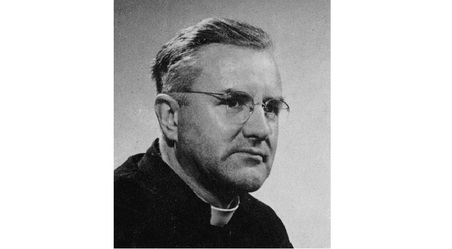
Edward Holloway
Life and life more abundant
Christ is the full, total, and utterly consistent manifestation of that friendship of God to mankind. He is the measure of the maturity to whose fullness we are born to grow. He is the ultimate meaning of the Unity in which the universe is framed in expectation: "I have come that they may have life and have it more abundantly" (John )
A new vision must make the point, which needs making, that man is not self-fulfilled, nor morally autonomous. There is for us a control and direction, a law of life and being. It is centred in God, and God has communed, and is in communion with us. As God and man, Jesus is the norm of human joy and fulfilment.
(From a FAITH Magazine Editorial)
Jesus Christ: saviour and redeemer
From all of the foregoing mighty, definite, and doctrinal issues of common sense and divine wisdom we draw the mind and heart of modern youth yet further on. Through Psalmist and prophet and books of inspired wisdom, we listen to the groaning of all creation (Romans 8: 1 8 et seq) for that climax of God's work for man - his salvation and redemption in God himself, in the divine person of Jesus the Christ. We come to Christ the King: Heir of the Ages and all their wisdom and power, Son of man, in whom we are loved and wanted because of him. The devotion of past ages crowned his heart with love, though it was a crown of thorns we wove around his heart and his head. Much more now, in these days, and in that unity of vision and perspective in which we need to present our Faith, we can crown his sacred head with wisdom and truth. For he does crown the ages, in his becoming Son of Man, crowns it from the spawning of the universe, until he shall come again in power, bringing in perfection with a "new heaven and a new earth" (Rev.2 1: 1). Today we can, and we should, complement the devotion to the Sacred Heart of Our Lord, as the scat and symbol of love both divine and human, with the devotion to that Kingship of wisdom and good, which is crowned in his Sacred 1-lead. Through the Incarnation, that head of the eternal Word through which all things were made, expresses with incomparable power the meaning of his Kingship, and gives to the title of 'King' a meaning and a magnificence which will never grow out of date whatever political systems may come and go.
In the majesty that shines out from the face of Christ, crowned as King, we see the synthesis of all wisdom, natural and divine. The Son of Man is not only 'Lord of the Sabbath' as God, he is Lord of the sciences and Lord of theology as well. All is resolved in one unity, and one work, and one will in him. In our presentation of Christ we can, and today we must, sweep the eager young mind to see, and then to savour the full majesty of God in Christ. This is a majesty which embraces nature and the supernatural together, in one common wisdom. Then we must offer him to his people to be loved in union, and in a Holy Communion of their being to his divine being. Christ is not to be pondered simply as a higher wisdom, a more perfect truth. He is to be possessed in joy and in grace, in the fruits more abundant of that which we call his salvation and redemption.
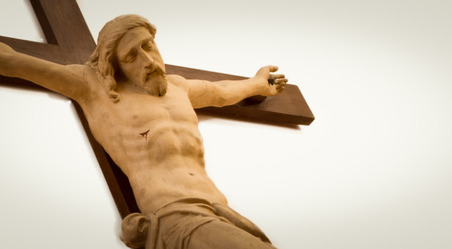
For the Old Testament expression 'salvation' is hard to translate into English by one word. It means an abundance of health in your being, and spiritual and physical well-being. It has overtones also of prosperity, joy, and protective care. When we gaze upon the crucifix, and see him who lies transfixed upon it, we understand better than from any sermon or tract the full horror of the meaning of sin, and the disaster to human nature of the fall of man. We begin to understand how Original Sin, even more than our personal sins, has dragged down the nature of man deep into a degradation of moral ignorance and blindness: how grievously it wounds the societies of men, and the cultures we form. We teach a wounding of human nature by sin it is true, not a total corruption of all good and all possibility, but gazing upon the crucifix we see a wounding of man so great that unless the redemption showed us otherwise, we would despair of any healing or salvation being possible for our race.
That redemption of Christ, that 'buying back' which consists in his satisfaction for our sins, in what does it lie? It lies in the perfection of his holiness, the perfection of his love, and the perfection of his obedience. Let us not try to separate the obedience from the love, because the 'obedience unto death' was a work and a witness accomplished on the cross by what is also a martyrdom. In him we are forgiven, because we are eternally wanted in him: as Son of man exemplar and first born of the race of men, he is the root and stock of our human race itself (Hebrews 2:14-18). He makes amends, because his perfection, his love, and his apology for us covers all things. Besides, he desires to have us, and at the Last Supper he claimed us by right of the work he was to do, and to suffer, on the morrow (John 17:24). There is so much to teach concerning Christ, which cannot be even named in this one treatise. But we preach it as the perfection of one work, a redemption won through struggle born of love. It should not have happened to Christ, but through sin it did happen, and he turned it into a loving redemption. We have to remember the same in our struggles to make him known and loved, in the persecutions we may bring on ourselves because of our loyalty to him. When we feel weary, and 'martyred' let us remind ourselves that he was the lonely prince of all his martyrs.
(Christian Formation pp 17-18)