


Ideas
New Synthesis cover

Sacraments and Prayer

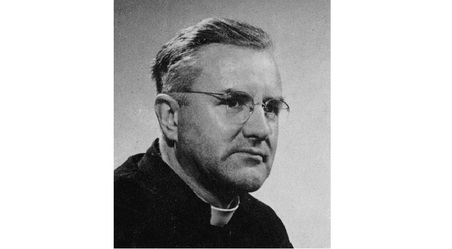
Edward Holloway

We yearn to know, and in that knowing more we love the more, for there is no loving except what is known. What is know must be approved in wisdom as the true and right, and desirable for us, and then we wish to possess. The fullness of truth, or knowledge, is proportionate to the fullness of the love.Our loving too is a yearning for more, even when we think we possess, if it were not so, there could be no hope, no further desiring. Our desiring will en only when the limit of our measure, as God has defined it in our being, shall be filled to the brim.

When we say that God is the fulfilment of man, and the Environment that conditions him to that fulfilment we are saying in a different idiom only that God is both the life and the Way to the Life. But we are also saying that in any order of the spiritual existence, even one less endowed than the actual economy of God we now have, man must, to be intelligible, rest in God the possession of God in Love. ‘Thou has made us for thyself, O Lord, and our hearts are restless till they rest in thee’ is true of any destiny that God accords a spiritual creature, even if the destiny had been less than that which God has given us in Jesus Christ. For there are degrees of the love and possession of God.

(New Synthesis pp 105-106.)


The Sacraments are an inevitable corollary of the Incarnation

The use of the picture, the symbol, the rite, is essential to Man because Man is a spirit enwrapped with the flesh. Both elements find their mutual harmony and fulfilment in co-operation, neither is meant to be in the original plan of God, a handicap upon the other. In the unity of his being, a man can only learn perfectly and love, and be fulfilled with perfection when both orders of his being co-operate of their own in a composite reality which like man himself is spirit and matter in the unity of one thing. The life of a man is well summed up in the human word itself, because this has no connatural meaning, but is an arbitrary and conventional sign, differing so much from nation to nation in the one interfertile species ‘Man’ that we do not understand each other without toil and translation. Yet, when we do translate, we find that there is a common denominator of meaning and significance in all languages, that we do in fact have the power to ‘understand’ mutually, even though these sounds for meanings are not similar organic an specific sounds programmed into our being through the brain, as in the case of the animals, who live on the deterministic level of reality. We are not computers. Therefore we have souls.It is inevitable therefore that Religion will be expressed through the sign and the symbol, as inevitable as the Religion will be social and organised, for Religion is the expression of the deepest natural power, orientation, need and expression of a man’s human being. When we say that the human word is a conventional sign it does not mean that to use words of some sort is arbitrary or conventional, no, the existence of the word is a necessary consequence of the reality of the flesh of the brain. No doubt at all, from the very nature of the highest simian that precedes man, the developed brain contained many organic and specific sounds for basic animal relationships interpersonal, social, environmental, and so forth; these will be and must be overpassed when the soul takes over in man the controlling function of the environment. No doubt at all that the co-operation of the soul with the brain will be natural, so that the human intelligence will find a ‘language’ ready at hand and easy to develop. But, because man is not just a super-brain, this means of communication will develop, and without relationship to either environmental control, or even organic and inherited sounds.As time goes on, and as human perception develops, new sounds and new pictures will have to be, and will be developed, which have no direct relevance to organic and inherited sounds. There is no other way in which we can make sense of human language, and the forms of human writing and signalling. These are not determined in a programmed way by the environment acting upon a brain which in fact, is the same organically in us all. If matter were all in man, there should be this sort of programmed similarity throughout the species. The obviously arbitrary nature of human language, by which a completely new and ideal language such as Esperanto can be formulated, is direct proof, if the argument is fully developed, of this thesis of the necessary distinction in man of soul an matter a principles of being in the unity of man’s one nature.Yet we agree that man cannot do without the intimate co-operation of matter with the spirit. Indeed, there is no immanent action in man, nor outward expression, which is not co-related to a material impression in his physical make-up as well. In the very wisdom of God that physical reality must participate, and participate at a noble level, in the religious knowing, loving, and adoration of mankind . It is quite rarely that this writer disagrees with St. Thomas Aquinas, but in this subject matter it cannot be helped. Aquinas presumes that except for the effects of sin, man would not have needed a sacramental economy, but could have gone perfectly to God through the way of contemplation. From his own philosophy of man as a composite being of matter and of spirit, of his doctrine of the soul as the as the entelechy or ‘form’ in man, and his recognition that all the immanent acts of human nature are ‘mixed’ in their order, St Thomas ought to have known just a little better in this context. He should have seen that sin or no sin, the perfect expression unto God of a mixed nature will be an activity which expresses fully for both soul and body the reality of the spiritual order. Once he has seen this, he would have recognised that the Incarnation follows naturally, in the wisdom of God, as the one and only plenary communication and communion of God with men. Apart from the Incarnation, only the angel who is pure spirit, could lay hold on God and be lain hold on, in perfection of ontological order: the sons of men would be left orphaned, because the flesh without the Incarnation is a nuisance, and an irrelevance in the spiritual order. The Hindu and Buddhist traditions, without an insight into the ‘contradiction’ introduced into the material order by Original Sin, are quite justified in seeing the flesh in this light, and in thinking that at the peak of perfection of being the spirit does not reincarnate but passes into identity with the Living Flame of the spiritual Absolute. The truth however is even more beautiful and subtle that this, for the doctrine of the East redounds into universal pessimism and rejection of the universal order of matter. It reduces the material in its essence to a defection from God, and this is not an explanation of creation. It is the very fact of the crowning of the material order by the direct enfleshing of God in Person which manifests the beauty and dignity of the material order, in the supreme destiny of the possession of God in his intimate Being. If the destiny of man is to the beatific vision of God, then the Incarnation is a necessity of divine wisdom and love, in the order of charity, because more than the strictly supernatural order, even God cannot give, and the only means to the fruition of the most perfect gift of God is the most perfect wisdom and love of God, given in his very Self. Just and sanctifying grace is the seed and germ of eternal life, so also the Incarnation is the germ and seed of the very possession of God in the beatific vision itself, for the spirit enfleshed.The institution of the symbol and the rite is inevitable from the nature of man, in any order of destiny, and is as natural to man in basic family and civic life as it is in religion. This, like the word, a spiritual content wrapped up first in a sound and then a graphic symbol, follows on the dualism of order through which ‘Man’ is integrated as a co-related entity in his being. Before the event we call the Incarnation, religious rites, even those which possessed the direct authority of God through the line of the Unity-Law, are still subjective and incidental means by which men cohere more fully unto God. They are not relationships from God to men, which are objective on the part of God himself, this has to await the Incarnation. This is why the living relationship of Christ to his Church at all times has been stressed so much, but especially in the Eucharist. For, of the Body and the People which is at all times integrated into this being, Jesus Christ is at all times the objective minister, and the objective nourishment.

The Eucharist : the centre of all

The Person of Christ in His Mysteries is enveloped by the incense of the prayers of his people. Let it be the luminous cloud which shines in our faces in the beautiful and hope-filled Masses we celebrate. The Person of Christ who comes upon our altar at the moment of the consecration, is the one source and origin of all our contemplation, and all our action.The Eucharist is our powerhouse of sheer contemplative knowing and loving, in joy and in sorrow. Live it that way, teach it that way. Love it, or rather love Christ Our Eucharist in that way.The essence of the beatific vision will not be in words and teaching, but in savouring and loving. So, here on earth the word goes out from Jesus Christ to draw us back again to the fullness of loving and of understanding the Master himself.Never forget this draw to the reverent contemplation of God in Christ in every Mass, whether solemn and high, plainsong or polyphonic, or folk, or something in between. The emphasis is not of concert, nor of theatre, nor of pop festival. The drama is the Master Himself, in all he has done, is doing, and will consummate in the life and history of mankind.

The Mass is never a "holy meal" which we celebrate around his ambiguous "presence". The Mass is the self-giving of the Son of God into which we are taken in humble love.

Dialogue of God and Man

‘My little children,’ urges St John the Apostle, ‘Love one another, for God is Love’. Man, made to the image and likeness of God by the spiritual nature, has God and not another creature as his principal end and fulfilment. This is to say that union with God is the purpose and goal through which all other purposes and joys are brought into focus and made harmonious within the personality of a man.‘God is Love’: if this be so, then God Love and Being are synonyms. If we be made to the image of God, then in us to love and to be are also synonymous. Not in us of course as in God, but love must be the fulfilment and perfection of our being in fact, and in experience, and so we find it.In us, knowing is a seeking, but in God knowing is possession and self-contemplation of all truth. In us, love is a desiring also, but in God self-possession of all joy. These considerations are important, because some men, even theologians at times, speak as if to know towards God, and to adore and love at God were an end in itself. This could not be so. Just as Love defines the Living Essence of God, so love which is possession must define the fulfilment of every spiritual creature.Our spirit is not found in the full possession of a total wisdom, by that we know that we have an end, that we are only a beginning and a seed, that we, like the seeds of material life, must expect a springing and a maturity. Our knowing is a yearning towards more, more wisdom, and more truth. Whether we know it or not, the end of the search is actually for he Wisdom who is God, in whom as last reason and truth all questions are solely answered.

(New Synthesis pp 309-311)