



Novo Millennio Ineunte
"At the Beginning of the New Millennium … our hearts ring out with the words of Jesus when one day, after speaking to the crowds from Simon’s boat, he invited the Apostle to "put out into the deep" for a catch: "Duc in altum" (Lk 5:4). (para. 1)
(Extracts from the Apostolic Letter
Novo Millennio Ineunte of Pope John Paul II to the Bishops, Clergy and Lay Faithful at the close of the Great Jubilee of the year 2000.)
1: Meeting Christ: The Legacy of the Great Jubilee
The basic vision that is opening up:
"The coincidence of this Jubilee with the opening of a new millennium has certainly helped people to become more aware of the mystery of Christ within the great horizon of the history of salvation … Understood in his divine and human mystery, Christ is the foundation and centre of history, he is its meaning and ultimate goal. It is in fact through him, the Word and image of the Father, that ‘all things were made’ (Jn 1:3; cf. Col 1:15)". (Para. 5)
2: A Face to Contemplate
" … the men and women of our own day—often perhaps unconsciously—ask believers not only to ‘speak’ of Christ, but in a certain sense to ‘show’ him to them. And is it not the Church’s task to reflect the light of Christ in every historical period, to make his face shine also before the generations of the new millennium?" (16)
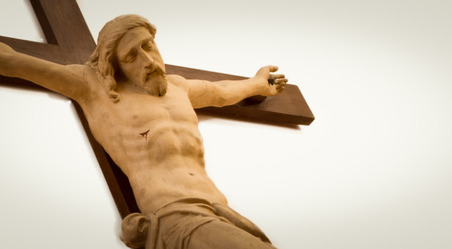
"God and Man that he is (Christ) reveals to us the true face of man"(23) as well as, "bring(ing) man back to the Father’s face … (by) burden(ing) himself with the ‘face’ of sin." (25). For "Jesus’ cry on the Cross (‘My God, My God why have you forsaken me’), dear Brothers and Sisters, is not the cry of anguish of a man without hope … At the very moment when he identifies with our sin, "abandoned" by the Father, he "abandons" himself into the hands of the Father. … Precisely because of the knowledge and experience of the Father which he alone has, even at this moment of darkness he sees clearly the gravity of sin and suffers because of it." (26)
In the remaining two chapters the Pope evokes the consequent attitude we must have in the new era, that of a Christ-centred charity towards others.
3: Starting Afresh from Christ
"Prayer … constantly reminds us of the primacy of Christ and in union with him the primacy of the interior life and of holiness"(38) "understood in the basic sense of belonging to (God) who is in essence the Holy One .. not .. as .. some kind of extraordinary existence … (but) according to the vocation of each individual." (31).
"… it is fatal to forget that ‘without Christ we can do nothing’ (cf. Jn 15:5)" (38). Silence (20), prayer (32-34), Sunday Mass (35-36), Confession (37) and prayerful bible reading (39) are crucial.
We need a balance between that "confidence (which never) hides the most radical demands of the gospel"
and that "respect due to the different paths of different people … taking into account each person’s needs with regard to their sensitivity and language, after the example of Paul who declared: "I have become all things to all men, that I might by all means save some" (1 Cor 9:22)". (40)
4: Witnesses to Love
"In a special way it will be necessary to discover ever more fully the specific vocation of the laity … (including) the promotion of forms of association, whether of the more traditional kind or the newer ecclesial movements, which continue to give the Church a vitality that is God’s gift and a true "springtime of the Spirit" (46)
"… special attention must also be given to the pastoral care of the family, particularly when this fundamental institution is experiencing a radical and widespread crisis. On this point the Church cannot yield to cultural pressures, no matter how widespread and even militant they may be. Instead, it is necessary to ensure that through an ever more complete Gospel formation Christian families show convincingly that it is possible to live marriage fully in keeping with God’s plan and with the true good of the human person—of the spouses, and of the children who are more fragile(47).
Ecumenism is still "unhappily
" so necessary: "As his Body, in the unity which is the gift of the Spirit, (the Church) is indivisible. The reality of division among the Church’s children appears at the level of history, as the result of human weakness in the way we accept the gift which flows endlessly from Christ the Head to his Mystical Body." (48)
"Charity towards the (materially) poorest" is an ongoing need and towards "financially affluent sectors and groups which are nevertheless threatened by despair at the lack of meaning in their lives, by drug addiction, by fear of abandonment in old age or sickness, by marginalization or social discrimination"(50).
In terms of the urgent pro-life effort (and with regard to related "delicate and controversial areas") it is crucial to stress "that it is not a case of imposing on non-believers a vision based on faith, but of interpreting and defending the values rooted in the very nature of the human person." (51).
Towards non-christians we should engage in respectful "dialogue .. not .. negotiation" which acknowledges that (the Church) has not only given, but has also "received from the history and from the development of the human race".
Conclusion
"Many are the paths on which each one of us and each of our Churches must travel, but there is no distance between those who are united in the same communion, the communion which is daily nourished at the table of the Eucharistic Bread and the Word of Life…. On this journey we are accompanied by the Blessed Virgin Mary to whom, a few months ago, in the presence of a great number of Bishops assembled in Rome from all parts of the world, I entrusted the Third Millennium (58) The Risen Jesus accompanies us on our way …may he find us watchful, ready to recognize his face and run to our brothers and sisters with the good news: ‘We have seen the Lord!’ (Jn 20:25)."
Get the full text from
www.vatican.va (32 A4 pages) or a
condensed version.