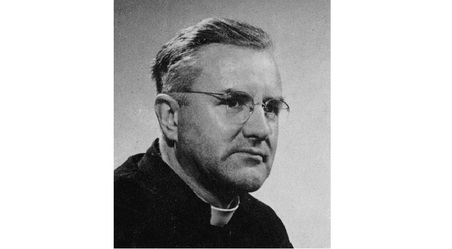


Profile on Patrick Burke, Editor FAITH Magazine
Bess Twiston Davies The Catholic Times, April 2001
The first time I met Fr Patrick Burke was on a youth retreat. I noted a fair-haired, mild-looking priest weaving his way dexterously to the head of the queue for the bar and returning swiftly with trays of drinks for his friends.
This air of discreet efficiency typifies Fr Burke. He doesn't stand out from the crowd, but he does get things done. Mind you, any priest who runs two Catholic parishes, is a university chaplain and edits a bi-monthly theological magazine would need amazing reserves of energy and organisational skills.
He is 35, and has been a parish priest for five years, since returning from the Teutonic College in Rome where he did a doctorate on the Vatican II theologian Karl Rahner after training at the city's Scots College.Rahner is clearly something of a hero to Fr Burke despite the fact he profoundly disagrees with his conclusions: "The Church took a tragic side step by embracing Rahner in the 1960s," he says blaming the current "pastoral problems in the Church" on the theologian.I explain that philosophy is a bit of a mystery to me. Very basic explanations are required. Fr Burke sighs mildly, but starts to perk up: "To understand what is going on in the Church today, you have to understand a bit of the history of the development of theology over the last 300 years.""The traditional theology of the Church was based for 800 years on the Thomistic synthesis which combined Aristotle with the data of Revelation. In the 18th century, Enlightenment thinkers rejected the traditional idea of a universe where all life was divinely ordered, instead promoting the self and personal experience as the measure of all wisdom. It was a theme first expounded by Descartes "I think therefore I am" but later developed by Kant, who doubted the ability of the human mind to know the true reality of anything. The idea that nothing is certain or objectively true has gone on gaining ground and is the underlying reason for our present moral chaos and loss of faith as a society. The Church at first responded by reasserting traditional neo-Scholastic philosophy, based on Thomas Aquinas. But some Catholic theologians attempted to bridge the gap by fusing Kant with Aquinas to produce a philosophy called Transcendental Thomism." And the greatest exponent of Transcendental Thomism was Karl Rahner, who has been in vogue in Catholic seminaries since Vatican II, hey-day of the Transcendental Thomists. A mistake, according to Fr Burke."In attempting to synthesise Thomas and Kant, they not only gave up on the objectivity of truth, but they essentially dismissed the relevance of the material sciences. It is a profound mistake to see philosophy having nothing to do with science. Historically they have always been inter-related. The Church says that God created everything, both mind and matter, so therefore there must be one synthetic principle behind it all. If it all comes from God we should expect it all to link up."Now, it is apparent, than rather being a pure philosophy class, science, never one of my strong points, is coming into the equation, too. "Albert Einstein's discovery of relativity which revealed time and space to be linked" prompted scientists to ask philosophical questions about the universe as a whole. For the first time with the theory of relativity it became possible to talk about the cosmos as a unity. Up until then all the cosmologists had done was to examine individual phenomena. Before that there was no understanding that there was an overall link between the various different laws of the universe.People knew that there was a law of this, and a law of that but they didn't realise that the laws were all actually aspects of one another. "This insight is our great opportunity for evangelisation. From this we can show the certainty of God, and then we can go on to show man's unique place in creation and the need for revelation and ultimately for the Incarnation itself. This way we could lead our culture back to seeing Christ at the centre of everything."Is this the answer to evolution? To all those cynics who point to Darwin as evidence that Christianity is a pack of lies?"Yes. We think that we have an answer to Darwin, by showing that random selection is both scientifically and philosophically flawed. With our line you can accept Darwin's basic understanding of an evolutionary world whilst refuting his particular theory of how evolution happened and so also avoiding the atheistic conclusions of his argument."It is a vision that Fr Patrick promotes in F magazine, the intellectual mouthpiece of the Faith movement, an association of priests, religious and lay Catholics which offers retreats and talks for young people. Faith's philosophy links science and divine revelation by arguing that all reality is created from a single structure related to the mind and will of God. Every living organism, it says, is shaped and directed by its physical environment, apart from Man. Alone of all creation, man possesses his own mind and will because he has a soul. So God is man's natural environment, the force which shapes and directs him towards his ultimate purpose "salvation and eternal life. This concept of the history of revelation " embracing all creation and the whole of man's journey towards God as a plan of wisdom and love centred on incarnation " echoes a theme which resonates strongly throughout the writings of Pope John Paul II. The FAITH magazine, which is published every two months, is a lively mix of accessible theology, comment on Catholic affairs, plus up-to-the-minute scientific news and analysis.Faith hasn't got all the answers but its supporters are "convinced that you have to maintain a synthetic approach to Catholicism. In other words that there is no contradiction between science and revelation".Speculative articles, including ones who question Faith's philosophy are encouraged, the only no-go area is attacks on the papacy.Fr Burke describes Catholic periodicals which delight in criticising the Pope and the Church as "almost the measuring stick of embittered liberalism: there is no charity. I think they are out of touch with the grassroots and out of touch with the universal Church".So is Faith conservative? Or actually quite revolutionary?"What we are doing is fairly radical. We are not saying 'maintain the status quo', which is conservatism. We are saying, 'yes, there were real problems in the Church stemming from neo-scholasticism, but there are also real problems with Transcendental Thomism. We think we have an alternative."Fr Burke is refreshingly free from any wishy-washy social-worker cliché's about his ministry: "My experience as a pastoral priest is that orthodox Catholicism works; that youth groups where we teach the faith, and challenge kids to live up to the ideals of Christian living, work; that the devotional life of the parish is extremely important; that where we have exposition of the Blessed Sacrament, where we encourage people to come to daily Mass and say the rosary, that these things work." The liberal establishment has had control of the Church for 30 years. Where is the renewal? Where is the reform? Where is the growth? The only growth point in the modern Church is in the movements, and the movements are almost all of them united in loyalty to the teachings of the Church, devotion to Christ in the Eucharist and so on "all the things that the liberal establishment have been trying to undermine for 30 years."He believes Catholics want holy priests, but the key is kindness. "It sounds a silly thing to say, but there is a compassionate way of upholding the Church's teachings. I tell seminarians on placements with me 'all the theology in the world won't help if you snap at people when they come to the front door'. It is difficult being a Catholic, but the problem is that most priests whose hearts bleed for people in difficulty simply abandon the Church's teaching. But there is a middle way." The Church knows it is difficult "it is not condemning you, but it cannot change the teaching of Christ."Fr Burke, who speaks with a marked southern English accent, runs two parishes in Central Scotland, at Bannockburn and Cowie "a result of having applied to the Archdiocese of Edinburgh after completing a degree in philosophy at St Andrew's University."His accent isn't a problem now, but in his early days in the Scots College in Rome he initially felt the odd one out: "I didn't realise there was such a cultural divide between Scotland and England and it was certainly very difficult to begin with, although looking back on it, I think it was all providential.""Most of the students were very Scottish and Celtic supporters. I was from a completely different background very middle class English, not particularly interested in football. But it got easier as time went by."With time his once acute sense of being English has diminished. "I don't really think I am English," he confesses. "I was born in Africa, I have an Irish passport, I lived partially in England. I spent more time in my life in Italy than anywhere else and I belong to a Scottish diocese, and I speak German."His background is equally cosmopolitan: a father from Limerick who settledIn Zimbabwe and a white Rhodesian (as the country was then called) mother. But as a small child, his family were forced to flee. "When I was four, my father had to leave Zimbabwe rather quickly. He was involved in the opposition to the Smith political regime in 1969, and we followed him in 1970. I don't remember much about it. I do remember how we had to leave our big house and move out very quickly.""For us, it was just excitement, an adventure, but for my mother it was very difficult. She had to leave all her family."In retrospect it seems an ideal preparation for the priesthood "letting go of home ties at an early age, trading particular cultural allegiances for the universality of the Church and upholding faithfully the timeless character of Catholic teaching."