


Articles
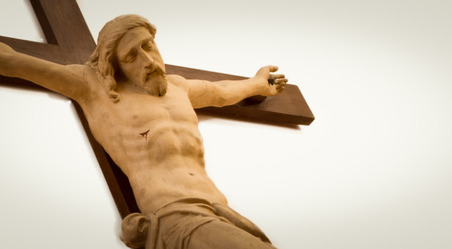
Christ on the Cross

To the Image of God: A meditation on the Christ

Edward Holloway


"In the beginning was the Word: the Word was with God, and the Word was God: the same was in the beginning with God. All things were made through Him and without Him nothing was made that was made". (John 1: 1-3)

This Eternal Word proceeds from the Father and within the Father, begotten, we say, by 'an intellectual generation' of like from like within the necessity of the Divine nature. Our creed proclaims it: "God from God, Light from Light, true God from true God begotten not made, of one Being with the Father". This same Eternal Word is also the model and type of the angels and of mankind.

It cannot be coincidence that when we contemplate our own self-possession, our own knowing and enjoying of our being, we find an extraordinary analogy. The self relativity of the Divine Being, by which God exists in Father, Son and Holy Spirit, is a metaphysical (i.e. absolute) necessity of being God. There is nothing in God which is not the necessity of being God. We would therefore expect something of this likeness to the divine self-relationship to exist in every spiritual creature, for we are made to the likeness of the nature of God. We could, (although it is not immediately relevant here), trace some sign or vestige of it in any created being, for the Being of God is the model, closer or most distant, of all that exists.

In The Light Of The Trinity In the deep quiet of the soul, that central "eye" of the spirit around which whirl the storms of life, its passions and greeds, loves and sorrows, we will find that we exist to ourselves in this way: I, knowing myself, loving myself, am. We may underline the reflexive pronouns - I, myself, myself - or the participles - the "processions" of knowing and loving. With either emphasis we are making the same point illuminated from different angles. Analyse your own consciousness and you find it to be true. There is a self-relativity within our own being that is the manner in which we consciously are and the way we must always operate when we interact with others.

The order in which our personalities unfold or procede is not an arbitrary one. We cannot logically put the 'loving' before the 'knowing'. We must self-reflect in knowing our spiritual content before we can affirm and enjoy our own being in authentic self love. The Word, who is the eternal Son, also proceeds from the Father according to knowing, and the Holy Spirit proceeds in the divine nature from the Father together with the Son according to loving.

In God, nothing grows or increases, for all is perfect and all is total. The Son is the fulness of the content of the divine intelligence, the self-affirmation of the divine nature through the Father, which is why 'begetting' is the most apposite term we can feebly use for the process. The Holy Spirit is the Personal love that proceeds from Father and Son through the divine nature, as God affirms and enjoys his very Self as Trinity.

In ourselves it is different of course. First, everything that proceeds within God is purely and simply God. Everything in God is self-subsistent and nothing is a 'part' or member of the divine nature. Thus, the Three Persons of the Holy Trinity are "subsistent relativities". This means Persons indeed, but not in the same univocal sense as in us, where knowing and loving are simply self reflections upon one limited personality. In God each procession is wholly and completely Himself, for the divine nature is centred simultaneously and totally in Being, Knowing and Loving, as the one absolute and perfectly fullfilled "I am". In us the knowing and loving are aspects of a work in progress.

In as much as we are made to the image and likeness of God, the content that we know and affirm within ourselves, the love which is the final term of our joy in being, is meant to grow through the years of life to a fulness. And the measure of that fulness is revealed to us in Christ: "We are God's work of art, created in Jesus Christ to live the good life as from the beginning he had meant us to live it" (Eph. 3:10) That fulness of the adult measure of Christ, of which St. Paul speaks a few verses further on, is also the fulfilment of our creation. For when we are willed into existence we are called to become 'co-sharers of the Divine nature'; the basic echo of which, though not its Divine perfection, we discover within our own created spirit and its body.

Not long before meditating this theme, the writer was asked by a very bright nine year old, how Jesus could be God's "Son" when God did not have a wife, and his teacher had told him that God the Father did not have a body either! So, dreamers and thinkers that we both are, we soon got around to discussing this business of the Holy Trinity, and "the begotten of the Father from all eternity" and so on. The young man took with delight to the idea of " I knowing myself, loving myself, am": He declared that when he thought about it, it was just so, - although he had never noticed it before!

It was so, I said, because we are made to the likeness of God, but only in a far off, distant sort of way. In us, because we are creatures and are not therefore self-sufficient, it comes out as three different relationships to ourself, but really only one person in one being. But because God is so much MORE, and everything that happens in Him is just simply and utterly GOD, the "I, Myself, Myself" comes out as three real, distinct Persons, but yet just the One God.

After hurling his cassock on the sacristy floor as usual, he went on his way down the church lawn rejoicing, skipping and proclaiming "I, knowing myself, loving myself, am: one, two, three, - just me"! I realised with a shock the that kid had gotten ahead of me in developmental insights, because I had never before seen the point of the "just me", but of course, when the Good God affirms Himself as Father, Son, and Holy Spirit: - One, Two, Three, just ME - The Lord proclaims Himself to be precisely The One God, in Three Persons.

The reality of God's self experience we cannot fathom. Jesus said: "Philip, he that sees Me, sees the Father also. Why do you say 'show us the Father' do you not believe that I am in the Father, and the Father is in Me" (John 14: 10). We can hardly bring it home to ourselves. Some of the saints claim an interior understanding and savouring of the Mystery of the Blessed Trinity.As far as this writer knows, they all said it was incommunicable to others through human language.

Nevertheless, we all savour something of God's self experience of his own Being through the Blessed Trinity within the very structure of divine revelation itself. Christian revelation is mediated from the Father, through the Son, and savoured in its full joy in the unity of the Holy Spirit. We can understand the Trinity in part in the "missions" or proper work attributed to the Father, the Son, and the Holy Spirit, in the economy of the Church, and the work of salvation. We live it in a real understanding, in the content and the majesty of the Church's solemn liturgy throughout the seasons of her year.

Christ: Sacrament Of The Angels? And unless we do meditate, however briefly and inadequately, the mystery of the Blessed Trinity as the Life of God, we cannot bring home to ourselves the enormous truth and richness of the title of Christ, as 'Sacrament of the World'. And this insight is important, because it is this vision of the meaning of Christ which, in its many applications, is the answer and development given to us by God to the problems and confusions of our age. It is also the only vision and title on which we will be able first to survive and secondly to revive and to evangelize the whole world really and truly so in the next century which is so nearly upon us.

A sacrament, properly so called, is an act of God upon man. It is not the name of a human action towards God, which God graciously accepts. Strictly speaking a sacrament is a communion of God, through Christ, by which God mediates to our human being some gift of the life of grace - some status or power, some vocation in the Church which is related to Christ's own Manhood and Divinity and which is therefore part of the life of the Church. Even when, like reconciliation, it is personal and proper to ourselves, the heart of the Christian sacrament (and it is something which our separated brethren do not yet teach or understand) is the communion of the Divine Life, through Christ, to mankind. Christ is the active minister and giver of the essential gift in every sacrament of the Christian Church.

We are asking now in what sense our very creation is a sacramental act of God, which stands in its fulness in the work of Christ over all. That fulness of God's work in Christ, from our theological perspective of course, extends from Creation to the Incarnation first and then to the working out of the mission of the Word made Flesh upon earth through the Church in history. Angels do not possess material bodies, but can we truly say that Christ, as the Eternal Word, is also truly the 'Sacrament of the Angelic Order' of creation, even as we call Christ Incarnate - the Eternal Word made Flesh - the 'Sacrament of the World'?

If we ask first what is God's motive in creating the creature, whether angel or man, there comes to mind at once the aphorism of a certain German professor of my student days, wagging his finger at us and thundering in a portentous voice: "In creando Deus non sibi vult plausores!" God did not create to be surrounded by hand-clappers! That must be right. God is totally self-fulfilled, nothing adds to or motivates his glory beyond the divine being. The motive must be the love that is pure gift. It is the sheer goodness of God's own being, by which he wills into reality the lesser and created, so that it can enjoy its own being fashioned upon his likeness and know within itself the urge to know and love and to seek him further in a total fulfilment of being, which is also an obedience of love.

In creating an angel God loves into existence 'adoptively' (for want of a nobler word) other being. God does so in the 'fiat' - the command to be of God's own Love - by a process of 'begetting' in the order of a non-necessary charity of goodwill which images as closely as may be the very process by which, within the nature of God, the Son is begotten of the Father and the Holy Spirit proceeds. It must therefore happen that the angels of God are mirrored in their created nature, in the order of charity, the order of the 'adoptive', through the Eternal Word - the alone necessary Only-Begotten of the Father through the divine nature. They proceed into being through that Love and 'fiat' which proceeds first, and alone necessarily, through the Father and the Son in the divine nature, and who is named by us The Holy Spirit.

In the order of gift, the angel of God is made by a process which copies the Self Manifestation of God within himself. The angel is conceived of the Father, known as 'begotten' through the Son, and effected in love through the Holy Spirit. The angel of God is thus made, in the order of gift and divine charity, a co-sharer in the divine nature and beckoned on to its fulfilment within the beatific possession of the divine nature itself.

Loved As God Loves Himself The question arises whether for the angels of God we can rationally talk of any 'natural' order of fulfilment less than the call to the co-sharing of the divine nature? With willing acceptance, as at all times, of the solemn judgement of the Church, this writer thinks not. Deus, in creando, non sibi vult plausores: there is no motivation for God, giving less than the gift of his own most total love to his creature, to be surrounded by adoring multitudes. Nothing adds to the glory of God in any intrinsic way. The angel is made through the simple nature of God, in knowledge through the Son, in God's own personal Love through the Holy Spirit; and the natural love of God is the supernatural by definition. For what in theology we call 'the supernatural order', in the proper, technical sense of the word, is the order of being which is proper and natural in God and to God alone.

Yet one will find no trace of any natural debt or claim upon the divine nature, for such is neither possible, nor intelligible. The divine nature is 'communicated' by necessity, claim, or debt only in the Father, the Son, and the Holy Spirit. Since we seem to be saying that the spiritual creature is by nature orientated and beckoned towards fulfilment in the divine nature and yet can make no claim of right on such a fulfilment, can we conclude from this that the nature of the spiritual creature is not fully intelligible, because it has no final end conformable to its nature, demanded by that nature, and closed, at least as a possibility, within the limits of "created natural happiness"? One would think this is so.

The animal in the field does indeed have such a 'natural' fulfilment proportionate exactly to its created being, because it does not participate in the spiritual nature, the order of 'soul' or of angelic spirit, at all. It is not in any substantial way made to the image of God. Whereas in the case of the nature of angel and of man - to whom we will come, more pertinently, in a moment - it is breathed to be and be-comes from the love that defines the being of God, which is supernature by definition; and unto that love, as co-sharer of the divine nature, it is beckoned on in the only possible perfect fulfilment of its being.

This writer must confess that there is another reason, a reason of the heart rather than of the head, for wishing to think and judge so. If we say that neither the angel nor man is perfectly intelligible as created, because it has no end or happiness naturally proportionate to its natural desire of knowing and loving God as God is, then we are forced to say that we men and the angels of God are not fully intelligible except in the order of a divine charity. We stand naked before the Divine Beauty. We cannot exist of ourselves. From Him alone we come, through his eternal will we live immortally, for better or for worse. Indeed, we have no natural, definable boundary to the meaning of our being, except within that one same order of totally gratuitous divine gift and divine love.

It is a total delight to be totally dependent in all things whatever upon the love and mercy of God. The prophet Moses writes of this same Almighty God: "He that is enthroned upon the heavens is thy helper - By his magnificence the clouds run hither and thither. His dwelling is above, and underneath (the earth) are the everlasting arms"(Deut. 33:27). If one had longer space one could make a better argument from the head for our being not fully intelligible except in the order of God's charity, but from the argument of the heart it is most delightful to have no support or right of nature other than the charity of those "everlasting arms". It is said the strong are gentle and the strong arms of God's love are more tender than a caress of nature's hands which, but for Him, are featherlight with the nothingness of their complete contingency.

The argument from the heart is the argument of the poet. Duns Scotus did it once, arguing to the fact of the Immaculate Conception in this way: Decuit: Potuit: ergo et Fecit; it was fitting, He was able, therefore He did it! In 1854 holy Mother Church ruled that the subtle Doctor's head was as good as his heart. St. Thomas too, if one remembers aright, answers the difficulty that man possesses in his inner being a natural desire of laying hold on God as God is, but no natural means of attaining such a desire, by saying that while man does not possess fur, claws, teeth and other attributes perfectly adapted to the end which defines his nature, as do lesser animals, man possesses reason and free will, by which he may by nature turn to God, who will provide him with the means of attaining that desire implanted within his nature, but which are beyond the powers of nature to accomplish. It seems an answer very similar to one's own suggestion. (Summa Theologiae 1a. 2ac. Art. 5 ad Iam)

Insight For The Twenty-First Century Whether or not the angelic nature or our own can theoretically be intelligible with its own claims to a natural fulfilment other than in the most perfect possession of God, we know in fact that God has made us, both angels and men, to find fulfilment only in his divine order, the order of the co-sharers of the Divine Nature. The essence of the Christian 'sacrament' (and as usual the Greeks express better its sheer depth by the use of the word 'mystery')is the life-giving communion of God upon the created spirit, by which we are made conformed to the image of the Word in the love of the Holy Spirit.

Christ, as the Eternal Word, is the creative principle of nature and of vocation beyond nature, to which the Angels of God are also made. Through him they also proceed in the Love between Father and Son. It seems right therefore to say that the principle of "sacrament" goes beyond the order of the divine working through the material - the "outward sign of inward grace" of traditional formulae. It belongs too to the order of being and invitation between the angelic nature and the Eternal Word before the Incarnation itself.

This would make a perfect sense and a total unity of the vision given both to St. John and to St. Paul (Colossians, Ephesians, Hebrews) by which all things, visible and invisible, were made through Christ as sacramental principle; and by which Christ holds the Primacy of Creation, over all things and in all things, in one vast Equation of being, of meaning and of fulfilment. As Eternal Word, not simply as Word made Flesh, Christ would be the Sacrament of All Creation, from creation to fulfilment in the order of gift and grace.

The spirit of the angel is created perfectly and totally to the likeness of that nature of God which is by definition Supernature. The angel is called to be a co-sharer of that one, simple, divine Nature; conformed perfectly to that Nature in a most free acceptance, but still by the outpouring of God's life-giving grace. The creation of matter, however, seems to be an irrelevance, because the material in its own order can never possess God, nor mirror him by substantial likeness. Why does God bother with humankind at all, because surely the being that is a synthesis of spirit and matter can never be united to God in so perfect a communion of likeness, wisdom and love as the angel of God can ?

This would be true in any vision of creation in which the Incarnation of God in Christ is looked upon as an afterthought of Man's creation, as it would be if the Eternal Word were decreed to be made Flesh only because of sin and the Fall, (which cannot be necessary or right in the order of God's creation, but a disobedience within it.) But how different it all appears if the full vision of St. John and of St. Paul is accepted and we realise that, in fact, God has given us an order of being as perfect as that of the angels, in the same creative charity, because He decreed our being in a relationship to the Divine Nature which was ordered, in its very creation, through the Humanity of the Eternal Word.

This is to say that our nature too was constituted, chosen and called through the Divine, through the Person of the Word - but the Word united in a communion of Person and being to the nature of the flesh! Any other vision of Christ is less than worthy of Him. No other vision of creation is as perfect in unity, simplicity and grandeur. In no other vision is Christ, by right of being and of creation, the Primate of All Creation. No other vision so totally fulfils the attributes of Christ delineated by St. John and St. Paul.

In this vision of creation and of salvation Christ is the Son of Man by a more magnificent title, because our very bodies are created in the first vision of God, (which is to say apart from the evil of original sin and the necessity of Redemption,) through the decree of the Flesh of the Word, who is Prince and Primate of our nature as fully and perfectly as He is of the nature of the Angels of God.

The Eternal Word is then Sacrament of the Angelic Order, ie. the principle of Life in which the pure spirit is conceived in charity and fulfilled into the divine nature. As Jesus Christ, the same Eternal Word unchanged, unlessened, undiminished, is the Sacrament of the Universe, because upon Him all the laws of its first explosion of energy into being is aligned and centred. He is its Alpha and Omega. Through and in Him, from the Father, in the unity of the Holy Spirit, it comes to be and will all be finally fulfilled. The Eternal Word, as Jesus Christ, is Sacrament of the World most intimately and most fully because here, at least, (of other worlds in time and space we know nothing) the Word was made flesh and dwelt among us, not only as Saviour but also in the further gift of reconciliation, as Redeemer.

Above all Christ the Sacrament of the World is in all things our Eucharist: our Thanksgiving, creation's centre and its song. He is the Living God to be adored by his people. He lives among them to be the centre of their life in time, and the centre of their lives in eternity. That is why it is folly and shame, as is the current fashion, to banish him to side altars and alcoves. It is a lie to say that the tabernacle in central place to eye and heart derogates from the celebration of the Eucharist.

He is the Eucharist; and the more we truly know and adore Him as Sacrament of His People, so much the more will we enter into his Sacrifice every time it is worked again and presented again in the same Person of the Son, in the Oblation we call the Mass. The development of the sacramental doctrine of the Church concerning the Eucharist was not an error. It culminated under the guidance of God in the feast of Corpus Christi. It is the prelude to a fuller and more awe-inspiring vision of Christ, Sacrament of All Creation, which is to be the sharp sword of the Holy Spirit for the evangelization of all mankind into the next century and beyond.

Christ: Vision Of Human Holiness So many wonderful things follow from this vision of Christ, and there is not enough space here to outline them. It would indeed need a book, not an article. First though, to put the finger on a modern error. It is a lie to say that in the past, the Church has emphasized the Divinity of Christ to the diminishing of his humanity. It is a lie of theologians who have already shown, some of them, that they did not believe in the literal and transcendent Divinity of the Lord of History. The humanity of Christ is useless to us without the Divinity of which it is the vehicle and manifestation. Christ is only the one Person.

But we never did devalue humanity, in Christ nor in ourselves, by orthodox and historic Catholic teaching. The soul is made for the body, not the body for the soul. And yet it is to the communion of our human spirit with the Living Being of God that we are called - body and soul. It is to this that the very order of the flesh must change until it is made one with the risen flesh of the Word made Flesh. It will remain matter-energy indeed, patterned to our one same soul, but now conformed to the 'spiritual body' of the Risen Christ - the "Heavenly Man" (as St. Paul puts it), not to the "earthy body" of the first Adam. It will be the matter and flesh of beings who now neither marry nor are given in marriage, but who live as the angels of God. (1Cor 15, Matt 22:30).

Another sign of the lie which suggests that we stressed the divinity but made the humanity less than human can be found in the devotion to the Sacred Heart of Jesus, even in its more extravagant and ruddily crude manifestations. As a boy I was put off by those living-room pictures of the Christ of the "Sacred Heart" found in every Anglo-lrish working class home. (The earnest, white, lined face of the Lord was enough to put many a red-blooded boy off the very thought of the priesthood! Fortunately, the Lord found other ways to reassure). Nonetheless the deep and tangible emphasis on the humanity of the Lord in traditional, popular devotion was evident. What these detractors really mean is that we stress the Divinity and draw up into it, in all its love, compassion and pain, the human reality of the nature of Christ as man. But we make him only one person, the Divine Person, whereas they want him to be a human person, totally one with us in Being, and 'divine' only in as much as he is highly and nobly human. That will not do.

We are made to the image of the Christ who, as Eternal Word, pre-exists his Incarnation among us. It is he who in the order of His own Divine Life beckons us on - contingent and 'other' as we are - to be made, by His perfect charity, truly "the brethren Thou has given to Me" - which is to say, the co-sharers with Him, in Him and through Him, in the unity of the Holy Spirit, of the very Nature who is God. When the chips are down, for this type of 'new theologian' (in reality a disciple of ancient Arius or even of Nestorius), the order of Supernature is the one natural order, and man, in their essentially pantheistic theology, is a direct emanation of the divine being itself. It is no wonder they do not believe in angels. On their theology, matter is spirit and spirit is the highest manifestation of matter. They are totally wrong; and their theology has terribly impoverished our priests and our people, especially the young and has also done much to de-sacralize the liturgy of the Eucharist in our parishes.

From this vision of Christ as Sacrament of the Universe and Sacrament of the World, space permits us to outline only one of a multitude of magnificent consequences. First, Christ is the manifestation of our creation into the order of Supernature, which is alone God's nature. Only through God taking unto Himself the order of matter, can the perfect unity of man's nature be made fully and truly in all things a co-sharer of the divine nature. Only through the decree of the Incarnation is the whole nature of man given exactly the same order of communion with God as is afforded to the angels. This writer would also suggest that the existence of man as a synthesis of matter and of spirit underlines the difficulty of finding any conceivable natural and proportionate fulfilment for man in a purely natural order of human happiness.

The soul is immortal by nature, the body certainly is not. If we invoke some intermediate "preternatural order" to justify the continuous immortality of the body in an order less than that of being 'co-sharers of the divine nature', we are already invoking a doubtful, in fact a rather cheating idea. For we have no clear concept by which we may define the bounds of what might be this "preternatural state", which is above nature, but yet, within the widest possible definition, must still be of a 'natural' order. What we can say, rather, is that in the face of Christ and in our calling through him into the family of God and his Angels, we see manifested the sheer fact that, but for sin, death - at least as we commonly know it and understand it - could never have been part of the original providence of God. Human nature is a unity. The body follows the end and purpose of the soul, and the soul is immortal. What God originally joined together in justice and holiness He could never have willed to be put asunder by "due process of nature", except through the extrinsic invasion and damage of original sin.

Man: Before Sin And Disorder Most of all, in the face of Christ, Sacrament of the Universe and of our planet earth, we see the ordered holiness of human nature as God intended it. It should have been a perfect order of personal peace and wisdom. The Body of Christ, ruled by the Divine Person, is just such an ordered peace and obedient wisdom of flesh and spirit. In that ordered wisdom all pleasures are ruled and taken within an exact and just proportion. There is no greed, no drive, no pleasure that is an end in itself. In the face of Christ we learn that the flesh is for the soul and both are for the Son of God and of Man. In the face of Jesus Christ we learn that he is the "first-born" of our stock - 'The Son of Man' - because our flesh is willed through his. We also see in him the model and image of holiness to which we are called in spirit and in the flesh. This call and vocation remains, even if through original and personal sin we can never fully attain it.

The Economy of Mankind Redeemed is not a different economy of God from the one made by God in Adam unfallen. The order is restored in Christ, the sin is forgiven in Christ and the command to seek a perfect holiness, to "put on the Lord Jesus Christ", remains and is our urgent, life-giving vocation. The vision of sheer, true, whole and holy Christian integrity in honesty, in humility, in due obedience, in charity, in justice and above all in chastity, shines out to us as a beacon in the human face, but divine Personality of the Only-begotten Son of God.

For reasons that we cannot develop now, in so many aspects of Christ's relationship to us as Sacrament of the World, this concept and all its riches is going to be supremely important in the years ahead of us. It is the one and only answer, in its fulness, to the Neo-Humanism and anti-Faith rationalism of our times within the Catholic Christian communion, and also outside that communion among our even more stricken 'separated' brethren.

In the Face of Christ, Exemplar and Primate of all creation, there shines out the dignity of every human being whatever - the most handicapped, the old and confused, the damaged by neurosis and drugs and by sexual addiction beyond repair. Each one is literally a cell of the Body of Christ, willed and wanted through the Son of Man, the original of our stock. How true it becomes that, "in as much as you did it to one of these the least of my brethren, you did it to Me"! Observe the capital in Me. The Son of Man is Son also in the Being of God. This vocation and dignity, which makes us all equal and overrules any possible distinction of genius, beauty, or grace of personality, extends also to the human embryo and to the first movements of life that is already human, (or at least defined only in and of the human order). This is the answer to many a modern problem. It is also the answer to the utter indignity and irreverence with which human sexuality is treated in its meaning and office and its fruit.

Finally, in the Face and Body of Christ we see the communion of every degree of human love, in perfect peace and order and in rightness of stress and valuation. To this perfection of order, according to our vocation, whether married or unmarried or dedicated to the work of the Kingdom in chastity, we are all called. Sex is not for loving, sex is for creation and life in a permanent state of loving. The meaning of the sexual communion is obvious in the seed of life which streams from it and in the fruitful conception which is its term. God never intended it to be an end in itself. If the fruit of that communion is unwanted, resented or dreaded, then it is man who is out of harmony with God.

In the mind of God there was nothing superfluous or misjudged. In the orginal state of humanity, if family and further children was rightly, holily, and justly not desired, then tenderness would remain, every other 'bonum conjugum' (blessing of marriage) would remain - love and its embrace could remain - but the genital arousal and its pleasure would neither be sought nor willed. Nor, apart from the concupiscence brought into the body through sin, would it have stirred. For the soul is by nature and by grace the principle of rule and control of the flesh of man. That is how is should be, was originally and is in the Face of the Son of Man.

To that order we may still weakly strive and in generous measure attain. But, to attain it we must possess the right vision of the real truth. It shines out in the Face of Christ, it speaks out in his Word, his Magisterium in the Church upon earth. The vision we outline shows us the many orderings and degrees of perfect human love - and how to be perfect it must be Christian love. It embraces not only marriage but also that higher love in chastity - deep and utterly fulfilling - which is the formation of men, especially the young, into the Kingdom of God. It embraces the complete communion of the contemplative monk or nun with the sheer love of God, in Father, Son and Holy Spirit, and the fulfilment in comradeship without erotic love that such communion grants and gives.

This vision entails so much more than we can here even indicate. It must suffice here to point to the same essential vision, given with more authority, through St. Paul:-

"Blessed be God, the Father of our Lord Jesus Christ Who has blest us with every spiritual blessing of heaven in Christ. Before the world was made, he chose us, chose us in Christ: To be holy and spotless, and to live through love in His Presence Determining that we should be made his children, adopted through Christ: for his. own kind purposes. To make us praise The glory of His grace, his free gift to us, in the Beloved. in whom, through his blood, we gain Redemption, the forgiveness of our sins.

Such is the richness of the grace He has showered on us, In all wisdom and insight. He has let us know the mystery of his purpose: the hidden plan He made so graciously in Christ from the beginning.To fulfil when times had run their course unto the end: That He would bring together all things under Christ as Head, Everything in heaven, and everything on earth." (Eph. 1: 2- 1 0).