



Religion And The Common Good
Editorial from the FAITH Magazine November-December 1996
The Bishops do have a right and responsibility to teach—and to teach the whole of the faith. The social teaching of the Church is an important and neglected part of that faith and a direct consequence of the doctrine of the divine vocation of man and the duty of Christian love of neighbour. In seeking to proclaim the Church’s, “best kept secret”, the Bishops of England and Wales have pointed out
The Church would be failing in moral courage if its social teaching were allowed to remain at the level of broad generalities in order to avoid controversy. (CG 54)
To say that the Bishops should keep quiet on such matters as social teaching and ecomonic justice is absurd. To say so in England is additionally to lack an elementary knowledge of our own Church history. Any strictures that are to be applied to the Bishops on grounds of “interfering in politics”, should be tested on the cases of Thomas Becket and John Fisher.
In Faith, we would also wish to be dissociated unambiguously from the manufactured outrage that has characterised the politically conservative response to The Common Good. Before launching into such vehement condemnations of bishops as “party pawns”, the political commentators would do well to consider the pedigree of the teaching to which they take such violent exception. (In some cases, they would obviously also do well to read the document they are criticising.) Contrary to one distinguished writer’s assertion, the bishops did not get the notion of subsidiarity from Europe – European political philosophy got it from from Pope Pius XI. Similarly, the analysis of the Church’s carefully balanced teaching that
the end result of market forces must be scrutinised and if necessary corrected in the name of natural law, social justice, human rights, and the common good. (CG 77)
is not the anti-conserative diatribe is has been represented. As the bishops comment, “Nor does the papal condemnation of unlimited free-market, or laissez-faire, capitalism apply indiscriminately to the Conservative Party.” (CG 56) The Common Good could not be held up as “anti-conservative” except by the kind of conservative who would find David Copperfield an attack upon their industrial relations policy.
Having said that, there is a gathering consensus that the comments on “single issue voting” are a major weakness. It is not that the pro-life groups are in favour of “single issue” voting. They have said—and with considerable political acumen in the case of SPUC—that it is a case of support for abortion being a disqualifying issue. An MP who consistently votes in favour of abortion or who gives a clear indication that this is his intention, should know without any doubt that he is thereby disqualified from receiving a Catholic vote. It is shallow to dismiss such an approach as a failure to distinguish between an election and a referendum. Catholic emancipation, the abolition of the slave trade and women’s suffrage were all achieved because they were given enough political limelight to become disqualifying issues for a large number of voters. To take such an uncompromising attitude would be more in keeping with the teaching of the Holy Father;
Abortion and euthanasia are thus crimes which no human law can claim to legitimize. There is no obligation in conscience to obey such laws; instead there is a grave and clear obligation to oppose them by conscientious objection. (Evangelium vitae 73)
Another pitfall which might have been avoided with advice from Catholic pro-life experts in the secular field of parliamentary lobbying is the talk of political candidates’ attitudes or views. SPUC has for years pointed out that what a candidate declares his views to be is no guide at all to how he will vote. The issue of abortion is one of the clearest examples of how this works in practice. A candidate who consistently votes in favour of free abortion on demand can quite earnestly declare that his “views” are against abortion. It is just that he has compassion on all those terrible hard cases…
However, in a more positive light, the bishops have shown that it is certainly possible to give a clear and sympathetic summary of Catholic teaching on various issues by means of a fairly brief and well-presented document. Perhaps the harm done unwittingly to the pro-life cause could be repaired by the issuing of a clear statement of the Church’s teaching on human life. The Common Good is an excellent example of how a complex area of the Church’s teaching can be presented attractively and concisely with the authority of the Bishops behind it. We must hope that the social teaching of the Church is not to be the only beneficiary of this approach.
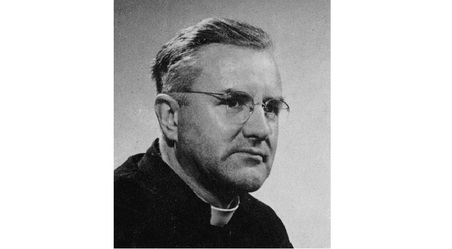
I would also like to suggest, from the standpoint of the Faith movement, a way of making sense of the social teaching of the Church, which the Bishops so carefully presented on the basis of the various papal statements. Years ago, well before the second Vatican Council, a radical young priest gained a certain notoriety in the Catholic press by his frequent offerings on the subject of such teaching. Although he later suffered a period of vilification as the archest of right-wing conservatives, he is now once again coming to be regarded as a dangerous leftie by some who mistrust talk of evolution, participated ownership or the realignment of Thomist philosophy. He could be dismissed as a fickle-minded awkward customer were it not for the documentary evidence that his views have not changed in those forty years of differing reception.
In the final chapter of Catholicism: a new synthesis, he argues that the right of ownership is never univocal. In every case, we participate according to degree in the sovereignty of God over the whole of creation and we participate as members of an organic community. Every instance of ownership of property
“stands in an organic relationship of control or of participation by others who are affected by such dominion” (Catholicism: a new synthesis p 486)
Moreover, it is impossible any longer to regard human communities as self-contained units. The brilliant essays of Christopher Dawson foresaw the rise of petty nationalisms after the collapse of communism over forty years before perestroika and increasingly it becomes true that modern wars between nations are in danger of becoming a “civil wars within the community of man” (ibid p488)
The reason for these developments in modern society is at heart a doctrinal truth which remains true despite all attempts to ignore it. We are made for Christ the King and for nothing and nobody else.
The supreme dominion over the earth as a planet and the inhabitation of mankind rests with God and rest specifically upon Christ as King. This is meant literally, and as no abstraction. It will follow that the claim which a man has, or which nations have, to work the earth and to be fulfilled upon it, is a personal claim from birth held upon the title-deed of spiritual personality, upon it being the common inheritance of their Father even God. The obligation of men to integrate their initiatives until we have in the end one common world society for the good of all and the fulfilment of all is not an abstraction either but a fact. We are members of a common family. (ibid p462)
Without such an understanding of man and of society it is difficult to defend the social teaching of the Church from first principles. It is these first principles which are under threat in the modern world and cannot be taken for granted.
Today … society bristles with unconscious assumptions of doctrinal and moral principles which survive the decline of doctrinal Christendom, and for which no purely extrinsic defence can be furnished. First, there is the presumption of the worth and lovableness of men, that in them which is worth redeeming so to speak. (ibid p450)
It is this consideration that makes the pro-life issue the most important of all and the rejection of the right to life a disqualifying issue for the vote of any Christian who would defend social teaching at all. The right to life is based upon the worth of human life, made for fulfilment in Christ, membered to other human life in community. Without such a fundamental understanding of the nature of man and his social relationships, social teaching on the right ordering of the economy is a house built on sand, however correctly constructed in itself.
With such a consideration, however, we return to what must at heart be the assertion of the Church’s right to exist. This is a hard saying, especially when one writes from South East England, aptly described by a Faith speaker as “the most secular corner of the planet”. Religion is regarded much in the same way as tending a pretty garden. It is a worthy hobby and one to encourage for a Sunday but the suggestion that one scheme would be intrinsically true is horrifying and narrow-minded. What the secularist does not consider, of course because this form of secularism grows on the abandoning of serious reflection, is that his own scheme of life and morality, whether public or private, is itself dogmatic and makes claims upon the whole community.
Thus, the state can easily usurp the functions of the Church without even realising that it has done so. The Church can look after the morning prayers and perform the appropriate ceremonial at life’s more significant moments but anything really important such as teaching on the morality of the fair arrangement of the economy or policy concerning international relations should preferably be left to those who are more sensible than to take religion too seriously.
The Church’s right to exist follows from the existence of God, our creation as spiritual beings and the economy of grace. The Church has the right to teach, to form our personality in the life of grace and to exercise jurisdiction over our conscience. The secularist who denies this rarely sees that he claims exactly the same rights for himself or for other secular agencies. Marriage and family life did not collapse in England without the influence of secular teaching which claimed the right to change hearts and minds. When the Church’s influence to teach and form is disposed of in society, the gap is not left empty. It is filled by others who teach as though they had divine authority. Much of the outrage against The Common Good carries more than a little of the same underlying denial of the Church’s right to exist except as a benevolent society on the margins of national life. While we do have serious reservations about the presentation of the right to life, the exercise of the teaching office itself is to be welcomed and respected.