
Saint John Paul II: A man truly alive
Saint John Paul II: A man truly alive
Sr Andrea Fraile
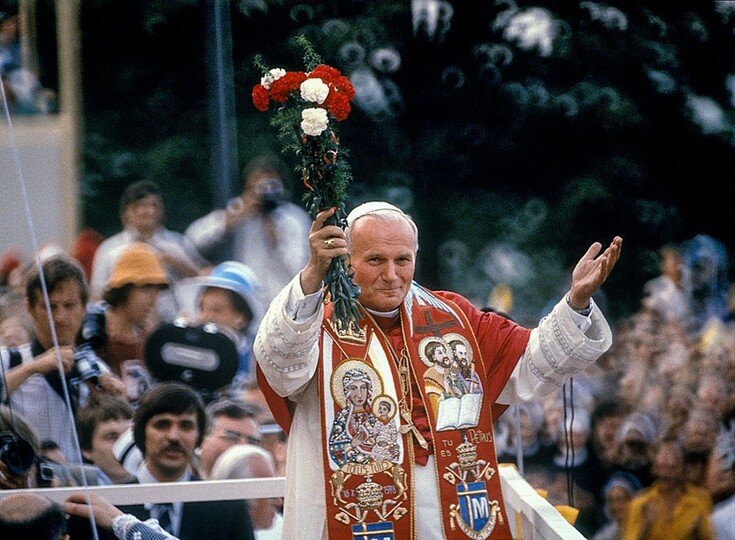
Pope St John Paul II, whose memory we honour today, was a man of such breadth and depth that it’s difficult to know which facet of his life to pin down in a few words. The most obvious angle for me, certainly, are his thoughts surrounding the encyclical he wrote 30 years ago, Evangelium Vitae (the Gospel of Life). Still, obvious as it might be, I’m going to stick with it: an issue that is more polarised than ever on both sides of the Atlantic, perhaps we should revisit this spiritual giant and enquire anew as to what it means to be pro-life. What did he mean when he wrote of the Gospel of Life and of creating a civilisation of love?
I was 20 years old when Evangelium Vitae was promulgated, and it was hardly a surprise to read an affirmation of the dignity and sacredness of every human person in the midst of the various assaults on human life that have led to what St John Paul rightly called the culture of death. But the words that really arrested me as I read it were the words of Christ Himself: “I have come that they may have life and have it to the full” (John 10:10). These words, that I’d heard so many times before, became in that moment a guiding light and the mustard seed of my vocation. It struck me then, and now with even greater clarity, that to be pro-life is so much more than saving lives at all costs – which is, lamentably, how the pro-life movement is increasingly perceived. It is about creating the conditions by which human life can be cherished and allowed to flourish.
John Paul saw the dignity of personhood through the lens of culture and, for him, a culture that has divorced itself from the Gospel is, de facto, a culture of death. (See Tracey Rowland, The Culture of the Incarnation for more on this.) The civilisation of love, on the other hand, is nothing less than the declaration of Jesus Christ as the Master Key to the meaning of the universe, the goal and fulfilment of human history.
The civilisation of love speaks of an attitude towards life and love so alien to what we commonly experience. It means that power and autonomy give way to love, vulnerability and dependence; it means that the heart, so often silenced by the head, is given space and time to reflect on what it truly desires; it means that the mystery of a person is welcomed and not reduced to mere biology and history; it means that creativity is nurtured and lauded as a thing that marks us indelibly as human, not as a sideshow to the serious business of work and frenzied productivity. Everything St John Paul was, everything he wrote and did, spoke to this flourishing of human life: the dignity of work, the inextricable link between faith and reason, theology of the body, the feminine genius; his towering presence in the face of Communism, the Carmelite spiritual tradition that resonated with him so deeply, his plays and poetry, his famous expeditions to the mountains with his students and so forth. (If these last two seem relatively unimportant, consider the words of Josef Pieper in Leisure: The Basis of Culture: ‘Leisure is a receptive attitude of mind, a contemplative attitude, and it is not only the occasion but also the capacity for steeping oneself in the whole of creation.’). The mystery of creation leads us to what is hidden and invisible and, when we see that, we have no trouble recognising the dignity and infinite worth of every human being.
Banners, slogans, chants and marches have their place but, for those pro-lifers who shy away from the polarisation and acrimony they represent, let us remember the life and witness of St John Paul for whom giving a family a pram, teaching a mother to make soup and encouraging a person to write are all part of the beautiful business of creating a civilisation of love.
Here was a man truly alive, who held the key to life for all of us: it is Jesus Christ who gazes at us and says, “I have come that you may have life, and have it to the full.”

Recent Blog Posts
Mary, the Rosary and the Logic of the Gift
Blog: 07.10.25 Mary, the Rosary and the Logic of the GiftFr Nick Welsh Since 1208 when Our Lady appeared to St Dominic, the rosary has been a staple feature of the Church’s devotional life and a powerful means of intercession. In certain ecclesiastical circles it is considered, pejoratively, as a pra...Read More
Saint Therese and total union with Christ
Blog: 01.10.25 “Story of a Soul” was the first autobiography of a saint I ever read. It was the winter of 2016, and I was given the book by a Carmelite nun whilst on retreat at her convent. For a 19-year-old who had only just begun to understand and experience the beauty of the Catholic faith, I was...Read More